
In a world of instant messages, emails, video calls, and notifications that appear on a screen within seconds, it is easy to forget how remarkable physical mail really is.
A simple envelope may look ordinary when it arrives in your mailbox. But behind that envelope is a system that has evolved for centuries.
Messages have traveled by horseback, ship, railway, automobile, and airplane. Postal workers, sorting facilities, transportation networks, and delivery routes have connected people across cities, countries, and oceans.
And even though digital communication has made sending a message almost instantaneous, physical mail still offers something different.
You can hold a letter.
You can recognize someone’s handwriting.
You can save a card in a drawer.
You can discover an envelope in your mailbox and wonder who sent it before you even open it.
That slower, physical experience is part of what makes snail mail so interesting.
For many people, snail mail offers something that digital messages cannot quite reproduce: the anticipation of receiving something tangible.
Here are seven fascinating facts about the postal system, from ancient messengers and historic stamps to the modern appeal of happy mail.
1. Organized Mail Goes Back to the Ancient World
The idea of transporting messages over long distances is much older than modern postal services.
As ancient kingdoms and empires expanded, rulers needed reliable ways to communicate with officials, military leaders, and administrators who were far away.
One of the best-known early examples was the Persian messenger system developed during the Achaemenid Empire.
Under Darius I, a network of roads and relay stations helped mounted messengers move information between important locations. Instead of expecting one rider to travel the entire distance, messengers could use fresh horses and continue the journey through a network of stations.
The system was designed for speed and reliability.
Herodotus described the Persian couriers in his Histories, emphasizing their ability to continue their journeys through difficult weather and darkness. Later accounts of this system have often been connected to the famous wording associated with the United States Postal Service’s unofficial motto.
Of course, this ancient system was not the same as the modern postal service you use today.
Private individuals did not simply drop a stamped letter into a mailbox and expect it to arrive at another person’s home.
The important similarity was the concept of an organized network designed to move information efficiently from one place to another.
That basic idea would continue evolving for centuries.
2. The Penny Black Changed the Way People Paid for Mail
One of the most important developments in modern postal history happened in Britain in the nineteenth century.
Before prepaid postage became standard, the cost of sending a letter could depend on factors such as distance and the number of sheets in the letter. In some cases, the recipient was responsible for paying the postage when the letter arrived.
That system could make correspondence expensive and complicated.
Then came a major change.
In 1840, Great Britain introduced the Penny Black, a postage stamp featuring Queen Victoria.
It was part of a new approach associated with postal reformer Sir Rowland Hill: simplify postage rates and allow the sender to prepay the cost of mailing a letter.
The Penny Black covered the one-penny rate for letters weighing up to half an ounce, and because it went on sale first, it is widely regarded as the world’s first postage stamp.
The change was significant because postage no longer depended on the recipient paying for the delivery in the same way.
A small adhesive stamp became a simple visual indication that postage had been paid.
The Penny Black also became an important part of postal history in its own right.
Today, it is recognizable to collectors and history enthusiasts around the world.
3. America’s First Postage Stamps Featured Franklin and Washington
The United States developed its own postage stamp system several years after Britain’s Penny Black.
The first general-issue U.S. postage stamps went on sale in New York City on July 1, 1847.
There were two designs.
The five-cent stamp featured Benjamin Franklin, while the ten-cent stamp featured George Washington. The stamps were issued on sheets without perforations, so clerks had to cut individual stamps apart with scissors.
Before this system, postage could be handled differently. A postmaster could mark the amount due on a letter, and postage could be paid in advance by the sender, collected from the recipient, or handled partly in advance and partly upon delivery.
The development of postage stamps made the process much more standardized.
And stamps soon became more than a practical way to show that postage had been paid.
They became tiny pieces of art and history.
Countries began using stamps to feature presidents, monarchs, historical figures, animals, landscapes, cultural traditions, important events, and national symbols.
4. Mail Has Traveled by Horses, Trains, Ships, and Airplanes
The postal system has always depended on transportation.
Long before airplanes and delivery trucks existed, horses and riders were essential for moving messages.
Stagecoaches later became an important part of mail transportation, and railroads dramatically expanded the ability to move large quantities of mail across long distances.
Trains offered an important advantage: they could carry substantial amounts of mail while traveling on established rail networks.
As automobiles and trucks became widespread, they made local and regional transportation more flexible.
Then aviation changed long-distance mail once again.
The first scheduled U.S. airmail route began in 1918 between New York and Washington, D.C.
Over time, mail became increasingly connected to a complex transportation network.
Today, letters and packages can move through combinations of trucks, aircraft, processing facilities, distribution centers, automated equipment, and computerized systems.
The technology has changed dramatically.
The basic purpose has not.
A message still needs to travel from the person who sends it to the person who receives it.
5. A Letter Goes Through More Steps Than You Might Think
Have you ever dropped a letter into a mailbox and wondered what happens next?
The envelope seems simple, but its journey can involve several stages.
Once it enters the postal network, the mail is collected and transported to a processing facility.
There, it can be sorted according to its destination.
Modern postal systems process enormous quantities of mail, so automation and sorting technology play an important role in moving letters efficiently through the network.
The mail may then travel through additional transportation and processing stages before reaching the region where it will be delivered.
Eventually, it reaches a local delivery facility and is assigned to a postal carrier.
The carrier takes it along a delivery route and brings it to the recipient’s address.
So when you open your mailbox and find a single envelope waiting for you, you are seeing only the final part of a much larger journey.
That envelope may have traveled hundreds or thousands of miles before reaching your hands.
The U.S. Postal Service describes its history as one closely connected with the development of transportation in America, including railroads and air travel.
6. Handwritten Letters Can Become Pieces of Personal History
A letter can be much more than a method of communication.
It can become a keepsake.
Think about an old birthday card saved in a box.
Or a handwritten note from a parent.
Or a postcard someone sent from a trip decades ago.
The paper may be inexpensive.
The handwriting may be imperfect.
The message may be short.
But together, those details preserve something that a digital message does not always capture in the same physical way.
Handwriting is unique.
People have different letter shapes, spacing, pressure, and styles.
Even small imperfections can make a letter recognizable.
A crossed-out word, a little doodle, or a handwritten signature can remind you that another person physically sat down and created that message.
Old family correspondence can also become valuable to future generations.
A letter can preserve vocabulary, handwriting, personal stories, everyday details, and a glimpse of what life was like at a particular moment.
Years later, opening an old envelope can feel like opening a small window into the past.
That is one reason people continue to save physical correspondence even when most everyday communication has moved online.
7. Snail Mail Creates a Different Kind of Anticipation
Digital communication is incredibly convenient.
A text can cross the country in seconds.
An email can reach another continent almost instantly.
Photos, videos, and messages can all arrive on a screen without any waiting.
Yet physical mail offers a completely different experience.
Someone has to choose what to send.
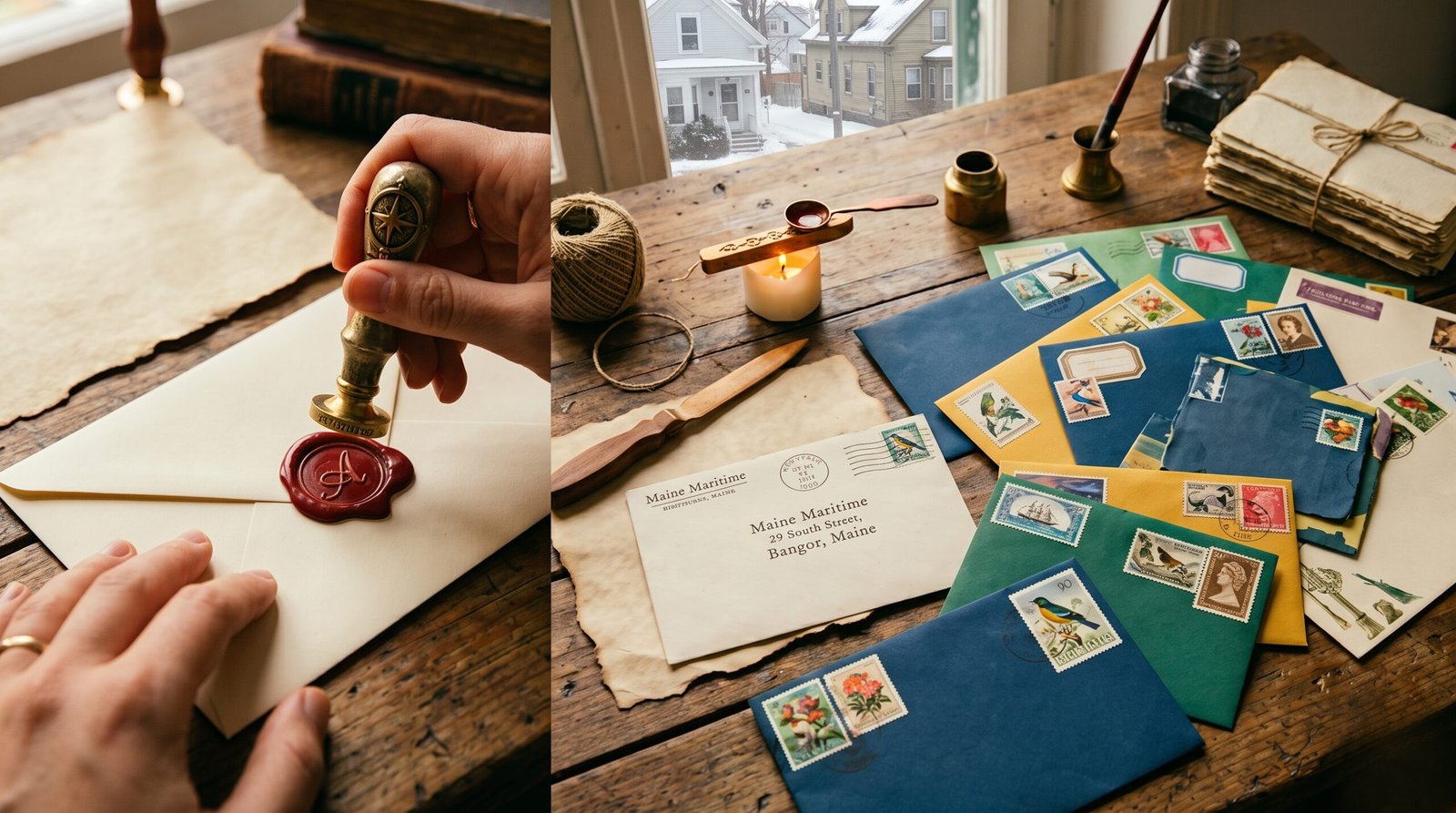
They may choose a card, write a message, decorate an envelope, select a stamp, and physically place the item into the postal system.
Then comes the waiting.
The recipient doesn’t know exactly when the envelope will arrive.
When it finally appears in the mailbox, there is a small moment of discovery.
Who sent it?
What’s inside?
Why did they send it?
That anticipation is part of the charm of snail mail.
A digital notification can disappear among dozens of other alerts.
A physical envelope sits there waiting to be opened.
You hold it.
You turn it over.
You open it.
And suddenly, something that traveled through the physical world has arrived specifically for you.
That experience helps explain why people continue enjoying handwritten cards, postcards, stationery, pen-pal exchanges, and happy mail.
Snail Mail: Why It Still Matters
The phrase snail mail is usually used humorously because physical mail is slow compared with digital communication.
But slow doesn’t necessarily mean unimportant.
In some ways, the slower process is exactly what makes physical correspondence special.
Writing a letter requires more intention than typing a quick message.
You have to decide what you want to say.
You have to put the words on paper.
You have to prepare the envelope.
And then you have to wait.
That extra effort can make the message feel more personal.
The recipient also experiences the anticipation.
Instead of receiving a notification instantly, they have time to wonder what might be waiting for them.
The waiting becomes part of the experience.
And in a world where so much communication is designed to happen immediately, doing something slowly can sometimes make it feel more memorable.
Mail Can Connect Different Generations
Physical correspondence can also introduce different generations to one another’s experiences.
Older generations may remember when letters were one of the primary ways people stayed connected with relatives and friends who lived far away.
Younger people have grown up surrounded by smartphones, instant messaging, social media, and video calls.
Sending physical mail can introduce them to another kind of communication.
For younger generations especially, snail mail can be a simple way to experience a slower and more personal form of communication.
A child might enjoy decorating an envelope.
A teenager might send a postcard from a vacation.
A parent might save a handmade card from their child.
A grandparent might keep letters from family members for years.
These small objects can become reminders of specific people and moments.
And unlike a digital message buried inside an inbox, a physical card can remain visible on a shelf, inside a drawer, or in a memory box.
The Return of Happy Mail
Although digital communication dominates everyday life, physical correspondence never completely disappeared.
People still collect stationery, exchange postcards, decorate envelopes, participate in pen-pal communities, and send small surprises through the mail.
If you enjoy discovering simple hobbies and creative ideas for everyday life, you can also explore more inspiration here at Bloom Magnolia.
This renewed interest in snail mail shows that physical correspondence can still feel meaningful even in a digital world.
This is where the idea of happy mail becomes especially interesting.
Happy mail isn’t necessarily about sending something expensive.
It is about the experience of opening the mailbox and finding something personal, colorful, thoughtful, or unexpected.
Instead of opening an app, you open an envelope.
Instead of seeing a notification, you discover something physical.
Instead of scrolling past another message, you have something you can hold.
That simple difference can make the experience feel special.

Sparkle Mail Club: Bringing Happy Mail Into Modern Life
If you love the idea of receiving something special in your physical mailbox, Sparkle Mail Club brings the tradition of happy mail into a modern setting.
The idea is simple: receiving physical mail can still be a small source of excitement in everyday life.
The club offers curated physical mail designed to add a little brightness to your mailbox, with items such as art prints, stickers, and handwritten notes.
It is inspired by the simple pleasure of opening an envelope and discovering something that was prepared specifically to bring a little joy.
Whether you enjoy stationery, small art pieces, colorful stickers, or simply miss the feeling of receiving something other than bills and advertisements, happy mail can make checking the mailbox feel different.
Because physical correspondence is part of the experience, the goal isn’t simply to receive another item.
It is to create a small moment of anticipation.
A colorful envelope can turn an ordinary mailbox visit into something you actually look forward to.
And sometimes, that is the appeal of snail mail in the first place.
Why Physical Mail Feels Different From Digital Messages
There is no question that digital communication is useful.
It is faster.
It is convenient.
It allows people to communicate across enormous distances almost instantly.
There is no reason to give up those advantages.
Physical mail simply offers something different.
A handwritten note shows that someone spent time putting words on paper.
A decorated envelope can reflect someone’s personality.
A postcard can remind you of a place someone visited.
A birthday card can become a keepsake.
A letter can be saved for years.
These physical qualities give mail an emotional dimension that is difficult to reproduce through a screen.
The difference isn’t necessarily that one form of communication is better than the other.
They simply create different experiences.
Digital communication is excellent for immediacy.
Physical mail can be meaningful because of the time, effort, and anticipation involved.
What the Future of Mail Might Look Like
The postal system will continue to evolve.
Digital communication will remain an important part of everyday life, and postal networks will continue adapting to changes in technology and consumer habits.
Some forms of communication that were once delivered primarily through physical mail have already moved online.
Bills, announcements, invitations, and personal messages can often be delivered digitally.
But that doesn’t mean physical mail has lost all of its value.
There are still moments when receiving something physical feels appropriate.
A wedding invitation.
A birthday card.
A handwritten thank-you note.
A postcard from a trip.
A letter from someone you love.
A small surprise from a friend.
These objects can be kept, displayed, reread, or passed down.
The technology surrounding mail may continue to change, but the human desire to connect is much older than any particular postal system.
A Tradition Worth Keeping
The history of the postal system shows just how dramatically communication has changed.
Ancient Persian messengers traveled through organized relay networks.
Postage stamps changed the way people paid for letters.
Railways and airplanes transformed transportation.
Modern sorting systems process enormous volumes of mail.
And yet, the basic human purpose remains remarkably familiar.
Someone writes something.
Someone sends it.
Someone receives it.
That simple process can still create a moment of connection.
Snail mail may be slower than a text message, but its slower pace can also be part of its appeal.
Perhaps that is why snail mail continues to have a place in modern life, even as technology makes communication faster than ever.
It gives people something physical to hold.
It creates anticipation.
It preserves handwriting.
It can turn an ordinary envelope into a keepsake.
And sometimes, in a world where almost everything arrives instantly, taking the time to send something through the mail makes the message feel even more intentional.
That may be the most fascinating thing about snail mail of all:
the technology keeps changing, but the desire to connect never really goes away.