
Have you ever put on your favorite pair of leggings, only to spend the next hour wondering why your legs suddenly feel itchy?
Leggings are supposed to be comfortable. They are stretchy, soft, easy to move in, and perfect for everything from workouts to running errands. So when a pair that normally feels great suddenly makes your skin itch, the problem can be surprisingly frustrating.
So, why do leggings itch?
The answer isn’t always the fabric itself.
Itching can happen because of friction, trapped sweat and heat, irritation from laundry products, or a reaction to something in the fabric or clothing dye. In some cases, an itchy rash may be a sign of contact dermatitis, a skin reaction caused by something that touches the skin. The American Academy of Dermatology notes that clothing dyes, fabrics, and some synthetic materials can irritate sensitive skin or contribute to contact dermatitis.
The good news is that you can often narrow down the cause by paying attention to when the itching starts, where it appears, what the leggings are made of, and what else has recently changed.
Here are four common reasons leggings may make your skin itch—and practical ways to make them more comfortable.
1. Friction From Tight or Repetitive Movement
One of the simplest explanations for itchy leggings is friction.
Leggings fit closely against the skin, which means the fabric can repeatedly rub against your thighs, knees, waist, or other areas as you walk, exercise, or move throughout the day.
This can become more noticeable when the leggings are especially tight or when the skin is already dry or sensitive.
During exercise, the combination of movement, moisture, heat, and fabric rubbing against the skin can make irritation more noticeable.
This doesn’t necessarily mean you are allergic to the leggings.
Sometimes the problem is simply that your skin is being exposed to more mechanical irritation than usual.
Signs friction may be the problem
Pay attention if:
- The itching appears after walking or exercising.
- It is concentrated where the fabric moves against your skin.
- The skin feels irritated rather than intensely inflamed.
- The problem improves when you change into loose clothing.
- The leggings feel unusually tight or restrictive.
If your skin feels fine when you wear loose pants but becomes irritated after several hours in tight leggings, friction may be part of the explanation.
How to reduce friction
Start with the simplest changes.
Try wearing leggings that fit comfortably rather than compressing areas that don’t need compression.
You can also experiment with a different fabric construction or a slightly looser fit.
After exercising, change out of damp leggings instead of staying in them for an extended period.
If the skin is already irritated, giving it some time without tight clothing can also help reduce further rubbing.
2. Sweat and Heat Can Make Itching Worse
If your leggings only seem to itch during workouts or on hot days, sweat and heat may be contributing to the problem.
Tight clothing can hold warmth and moisture close to the skin. Add exercise, repeated movement, and sweating, and your skin may become more irritated.
DermNet notes that textile-related dermatitis can become worse with constant rubbing from clothing and sweating, particularly in warm or humid conditions.
This is one reason the same leggings may feel completely comfortable on a cool morning but irritating during a hot workout.
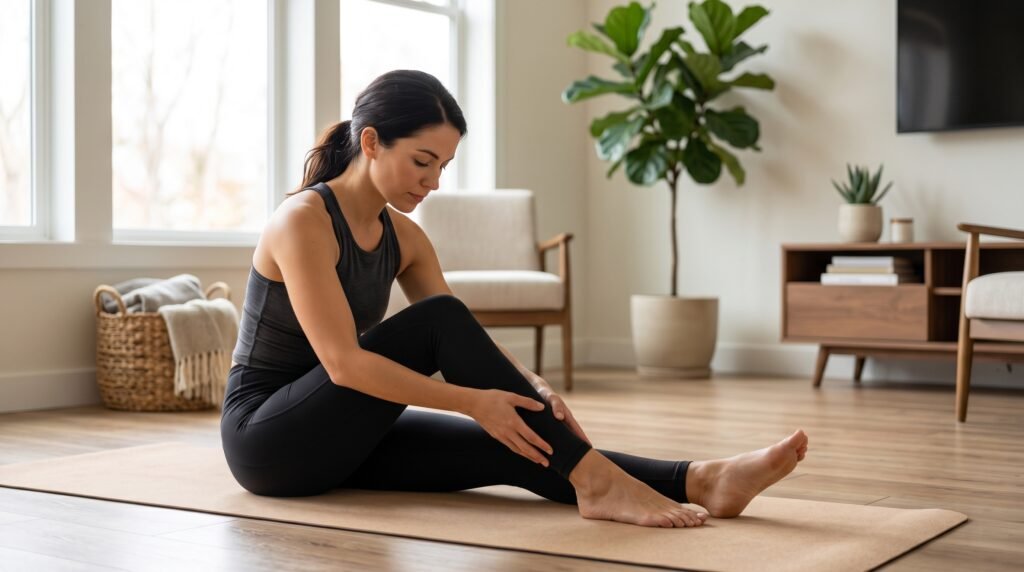
Why sweaty leggings can feel uncomfortable
Sweat itself isn’t necessarily an allergy.
The problem can be the combination of:
- Heat
- Moisture
- Friction
- Close-fitting fabric
- Already-sensitive or dry skin
When these factors occur together, irritation can become much more noticeable.
What you can do
If sweat seems to be the trigger, try changing out of workout leggings relatively soon after exercising.
Wash them according to the care instructions and allow them to dry completely before wearing them again.
It can also help to choose workout clothing that feels comfortable rather than excessively tight.
If the itching happens consistently during exercise and is accompanied by a rash, bumps, burning, or other symptoms, don’t automatically assume the leggings are responsible. A dermatologist can help determine whether another skin condition may be involved.
3. Your Laundry Detergent or Fabric Products May Be the Culprit
Sometimes the leggings aren’t actually the problem.
The culprit may be what you use to wash them.
Laundry detergent, fabric softener, fragrance, or other products can leave substances on clothing that remain in prolonged contact with your skin.
If your skin is sensitive, those residues may contribute to irritation.
The American Academy of Dermatology specifically recommends fragrance-free products for people dealing with contact dermatitis and notes that fragrances are among the common causes of allergic contact dermatitis.
A simple way to investigate
Think about whether anything changed shortly before the itching started.
Did you:
- Switch laundry detergent?
- Start using fabric softener?
- Try scented laundry beads?
- Buy a new type of laundry product?
- Wash the leggings differently?
- Start using a new body lotion or skincare product?
If the answer is yes, the leggings may simply be carrying the new product against your skin.
Try a simple reset
For a short period, consider washing your leggings with a fragrance-free detergent and skipping fabric softener.
Wash the clothing according to its care instructions and see whether the irritation improves.
If several different pieces of clothing cause the same problem, that makes the detergent or another common product more worth investigating.
And remember: “unscented” and “fragrance-free” are not necessarily identical. The American Academy of Dermatology recommends looking specifically for products labeled fragrance free when trying to avoid fragrance-related reactions.
4. The Fabric, Dye, or Another Clothing Material May Be Irritating Your Skin
This is the explanation many people think of first when they ask, why do leggings itch?
And sometimes, it really can be related to the clothing.
But the important distinction is that an itchy reaction doesn’t automatically mean you’re allergic to the fabric itself.
Clothing contains more than just fibers.
Dyes, finishing chemicals, elastic materials, rubber components, and other substances used during manufacturing can potentially irritate the skin or trigger allergic contact dermatitis in susceptible people.
The American Academy of Dermatology notes that clothing dyes, fabrics, and other materials used in clothing can contribute to contact dermatitis, particularly when a person becomes sensitive to a specific substance in the garment.
DermNet also explains that textile contact dermatitis can involve substances incorporated into clothing, including certain dyes, rubber-related chemicals, and other textile components.
How to tell if a particular pair is causing the problem
Look for a pattern.
Does the itching:
- Start shortly after putting on one specific pair?
- Return every time you wear that pair?
- Improve when you stop wearing it?
- Appear primarily where the fabric touches your skin?
- Come with redness, scaling, bumps, or a rash?
If so, that pair deserves closer attention.
One useful experiment is to stop wearing the suspected leggings and see whether the symptoms improve.
You can then compare your experience with another pair made from a different material or in a different color.
This isn’t a substitute for medical testing, but it can help you identify a possible trigger.
If the reaction keeps returning, a dermatologist can investigate whether contact dermatitis or another skin condition is responsible. Patch testing may sometimes be used when an allergic trigger needs to be identified.
Why Black or Dark Leggings Sometimes Deserve Extra Attention
If you notice itching primarily with certain colors of leggings, don’t automatically assume the color itself is the problem.
Different colors can involve different dyes or combinations of dyes.
The American Academy of Dermatology specifically notes that clothing dyes can contribute to contact dermatitis and suggests changing clothing color as one possible way to investigate a suspected dye reaction.
For example, if your skin reacts to several pairs of dark leggings but not to lighter-colored clothing, that pattern may be worth paying attention to.
Again, this doesn’t prove that the dye is responsible.
It simply gives you a useful clue.
Why New Leggings May Make Your Skin Itch
New clothing can sometimes cause irritation simply because of what remains on the garment from manufacturing, finishing, packaging, or handling.
That’s one reason dermatologists recommend washing new clothes before wearing them if you are prone to contact dermatitis.
The American Academy of Dermatology specifically recommends washing new clothing before wearing it to help remove chemical residues and dyes that could cause a reaction.
So before deciding that a new pair of leggings is unusable, try washing them according to the manufacturer’s care instructions.
If possible, use a fragrance-free detergent and skip fabric softener.
Then see whether the same reaction happens after washing.
How to Stop Leggings From Making Your Skin Itch
Once you’ve identified a possible trigger, the solution is often surprisingly simple.
Choose a More Comfortable Fit
Leggings shouldn’t cause persistent rubbing or uncomfortable pressure.
If a pair feels excessively tight, try a different size or style.
A comfortable fit may reduce friction and make movement easier.

Wash New Leggings Before Wearing Them
This is particularly useful if you have sensitive skin.
Wash new clothing before wearing it, following the garment’s care instructions.
Try Fragrance-Free Laundry Products
If you suspect laundry products are involved, simplify your routine.
Choose a fragrance-free detergent and avoid adding unnecessary scented products.
This makes it easier to determine whether something in your laundry routine is irritating your skin.
Change After Sweating
If itching tends to happen after exercise, change out of damp clothing instead of remaining in sweaty leggings for hours.
Keeping the skin cooler and drier can reduce the combination of heat, moisture, and friction that may contribute to irritation.
Don’t Keep Wearing a Pair That Clearly Causes a Rash
If one particular pair repeatedly causes itching and a visible rash, don’t keep forcing yourself to wear it.
Stop wearing the garment and see whether the symptoms improve.
If the rash continues or returns with other clothing, the leggings may not be the underlying cause.
How to Choose Leggings If You Have Sensitive Skin
Finding comfortable leggings isn’t necessarily about choosing one universally “best” fabric.
Different people tolerate different materials differently.
Instead, pay attention to how your own skin responds.
You might want to look for:
- A comfortable rather than overly tight fit
- Smooth seams
- Fabrics that don’t feel rough against your skin
- Clothing that doesn’t trap excessive heat for your particular activity
- Garments that can be washed without heavily scented products
- Materials you already know your skin tolerates well
If you consistently react to certain clothing, keep track of the material, color, brand, and laundry products used.
Patterns can be surprisingly useful.
When Itching May Be More Than a Clothing Problem
An itchy rash isn’t always caused by leggings.
Dry skin, eczema, contact dermatitis, fungal infections, insect bites, and other skin conditions can also cause itching.
That’s why the pattern matters.
If the itching continues even when you’re not wearing leggings, spreads beyond areas covered by the clothing, or keeps returning without an obvious trigger, consider talking with a healthcare professional.
The American Academy of Dermatology recommends seeing a board-certified dermatologist when an itchy rash does not clear or repeatedly returns because determining the underlying cause is important for effective treatment.
You should also seek medical advice if the rash is severe, painful, blistering, spreading quickly, or accompanied by other concerning symptoms.
A Simple Test to Find Your Trigger
If you’re trying to figure out why do leggings itch, don’t change ten things at once.
Instead, simplify.
For example:
Step 1: Stop wearing the pair that seems to cause the reaction.
Step 2: Wash your clothing using a fragrance-free detergent.
Step 3: Avoid fabric softener and heavily scented laundry products.
Step 4: Wear a different pair that you already know your skin tolerates.
Step 5: Pay attention to whether the itching returns.
If the problem disappears, you have a useful clue.
If you’re still wondering why do leggings itch, keep looking at the pattern instead of assuming the fabric is always the problem.
If it continues, the leggings may not be the cause.
This kind of simple observation can help you identify patterns, but it cannot diagnose a skin condition.
Why Your Favorite Leggings May Suddenly Start Itching
One particularly confusing situation is when you’ve worn the same leggings for months—or even years—and they suddenly start bothering your skin.
Does that mean the fabric changed?
Not necessarily.
Your skin can change too.
You may have developed increased sensitivity to something that previously caused no noticeable reaction. Your skin barrier may also be irritated or dry, making it more reactive than usual.
The American Academy of Dermatology notes that people can develop contact dermatitis from clothing even after wearing similar items for a long time.
A new laundry product, skincare product, seasonal change, increased sweating, or simple irritation can also change the situation.
That’s why it’s useful to look at everything that changed around the same time the itching began.
Why Do Leggings Itch? The Bottom Line
So, why do leggings itch?
There isn’t one universal answer.
For some people, the problem may be friction from a close-fitting garment. For others, heat and sweat may make irritation worse. Laundry products can also leave irritating substances on clothing, while dyes, fabrics, elastic, and other textile components can occasionally trigger contact dermatitis.
The key is to look for a pattern.
Notice which leggings cause the problem, when the itching begins, whether sweating makes it worse, what laundry products you use, and whether you develop an actual rash.
Then make one change at a time.
A different fit, a freshly washed garment, fragrance-free laundry products, or simply changing out of sweaty clothing may be enough to solve the problem.
But if the itching keeps coming back, becomes severe, or develops into a persistent rash, don’t assume your leggings are automatically to blame. A dermatologist can help determine what is actually causing the reaction and recommend appropriate treatment.
Sometimes the answer isn’t finding the “perfect” pair of leggings. It’s figuring out why do leggings itch in your particular situation, identifying the trigger, and giving your skin a chance to recover.



Post Comment