
How often should you wash your hair? It sounds like a simple question, but the answer isn’t the same for everyone.
Some people wake up with oily roots the day after washing, while others can go several days before their hair feels like it needs another shampoo. Curly, coily, thick, fine, straight, color-treated, and dry hair can all respond differently to the same routine.
That’s why the best hair-washing schedule isn’t necessarily the one you see trending online.
Your scalp, hair texture, lifestyle, activity level, and how quickly your hair becomes oily all matter. The American Academy of Dermatology recommends washing based largely on how often your hair becomes dirty or oily rather than following one universal schedule.
So, how often should you wash your hair?
The practical answer is: as often as your scalp and hair need it.
For some people, that may mean daily or every other day. For others, washing once or twice a week may be enough. People with very dry, curly, or coily hair may need even more time between washes, provided the scalp remains healthy and comfortable.
The goal isn’t to wash as little as possible.
It isn’t to wash every day either.
The goal is to find a routine that keeps your scalp clean and comfortable while protecting the hair lengths from unnecessary dryness and breakage.
Finding the Right Hair-Washing Schedule
There is no single number of days that works for everyone.
A better way to determine your routine is to pay attention to what your scalp and hair are actually telling you.
When deciding how often to wash your hair, start by paying attention to your scalp rather than following a fixed schedule.
If your scalp becomes noticeably oily, sweaty, itchy, or uncomfortable, you may need to wash more frequently.
If your hair feels consistently dry, brittle, or difficult to manage after washing, you may need to adjust how often you shampoo or change the products you’re using.
The American Academy of Dermatology notes that people with straight hair and an oily scalp may need to shampoo every day, while people with dry, textured, curly, or thick hair may need to shampoo less frequently.
Age can also influence your routine. Cleveland Clinic notes that younger people may have oilier scalps, while oil production can decrease with age. Hair length and texture can also affect how frequently washing is comfortable.
So instead of asking, “What is the perfect number of washes per week?” ask:
How does my scalp feel between washes?
That question is much more useful.
Signs You May Need to Wash More Often
Your hair may be asking for a wash if you regularly notice:
- Oily or greasy roots
- A sweaty scalp after exercise
- Product buildup
- Persistent itching
- Flaking or dandruff
- An uncomfortable scalp
- Hair that looks noticeably dirty
If you exercise frequently or sweat heavily, your scalp may need more frequent cleansing.
Cleveland Clinic notes that washing helps keep bacteria and yeast levels on the scalp under control, while signs such as itching, redness, flaking, or dandruff can sometimes indicate that the scalp needs attention.
However, persistent scalp symptoms shouldn’t automatically be blamed on your washing schedule.
Dandruff and scalp irritation can have several causes, and persistent symptoms may require evaluation by a dermatologist.
Signs You May Be Washing Too Often
More washing isn’t automatically better.
If your hair repeatedly feels:
- Very dry
- Rough
- Brittle
- Difficult to detangle
- More prone to breakage
- Frizzy after washing
your routine may need adjustment.
This doesn’t necessarily mean that shampoo itself is “bad” for your hair.
The issue may be the combination of washing frequency, shampoo formulation, water temperature, heat styling, chemical treatments, or the way you handle your hair while it is wet.
The American Academy of Dermatology recommends applying shampoo primarily to the scalp rather than scrubbing the entire length of the hair. This helps cleanse away excess oil, dead skin, and product buildup while limiting unnecessary drying of the hair lengths.
How Often Should You Wash Different Hair Types?
Your hair type is one of the biggest factors to consider.
How often you should wash your hair can vary significantly depending on whether your hair is fine, straight, wavy, curly, coily, thick, dry, or chemically treated.
Fine or Straight Hair
Fine or straight hair can show oil more quickly because natural scalp oils can travel along the hair shaft relatively easily.
If your roots become oily within a day or two, washing every day or every other day may be completely reasonable.
The American Academy of Dermatology specifically notes that people with straight hair and an oily scalp may need to shampoo daily.
You don’t need to force yourself to stretch wash days simply because someone online says daily washing is unhealthy.
Instead, use the condition of your scalp as your guide.
Wavy Hair
Wavy hair often sits somewhere between straight and curly when it comes to washing needs.
Some people with wavy hair can comfortably wash several times a week, while others may need more frequent cleansing if their scalp becomes oily.
Pay attention to both your roots and your waves.
If your scalp feels greasy but your lengths feel dry, focus shampoo primarily on the scalp and use conditioner where your hair needs moisture.
Curly Hair
Curly hair tends to be more vulnerable to dryness because natural oils don’t travel down the bends and curves of the hair as easily.
As a result, many people with curly hair don’t need to shampoo every day.
The American Academy of Dermatology recommends washing curly or coily hair when needed and notes that thick, curly hair may not need daily or even weekly washing, depending on the individual.
The important part is maintaining a healthy scalp while avoiding unnecessary dryness.
Coily or Tightly Curled Hair
Coily hair can be particularly prone to dryness and breakage.
The American Academy of Dermatology recommends washing Black hair about once a week or every other week in its general care guidance, while emphasizing conditioning and protecting the more fragile ends.
Your exact schedule can still vary depending on your scalp, styling routine, exercise, products, and personal needs.
Dry or Thick Hair
If your hair is naturally dry or thick, washing too frequently may leave the lengths feeling unnecessarily dry.
That doesn’t mean you should ignore your scalp.
Instead, concentrate shampoo where buildup and oil actually accumulate, then use conditioner to help keep the lengths manageable.
Color-Treated or Chemically Treated Hair
Color-treated, bleached, permed, or chemically processed hair often needs extra attention because the hair fiber may already be more vulnerable to dryness and breakage.
Rather than simply trying to extend wash days indefinitely, focus on gentle cleansing, conditioning, and minimizing unnecessary heat and mechanical damage.
Three Real Hair Care Hacks That Actually Help
You don’t need a complicated routine with dozens of products.
A few practical habits can make your wash days easier and help protect your hair.
Hack #1: Shampoo Your Scalp, Not Your Entire Hair Length
One of the easiest improvements you can make is changing where you apply shampoo.
Your scalp is where excess oil, sweat, dead skin, and product residue tend to accumulate.
The lengths of your hair generally don’t need the same amount of scrubbing.
Apply shampoo primarily to the scalp and gently massage with your fingertips.
You don’t need to aggressively scratch or scrub.
As the shampoo rinses out, the lather will travel through the lengths of your hair.
This approach can help cleanse the scalp without unnecessarily drying the ends. The American Academy of Dermatology specifically recommends focusing shampoo on the scalp.
Do You Need to Shampoo Twice?
Not necessarily.
Double shampooing can sometimes be useful when the hair contains significant oil or product buildup, but it isn’t a requirement for every wash.
If your scalp feels clean after one gentle shampoo, there is no reason to automatically repeat the process.
If you’re using a clarifying or medicated shampoo, follow the instructions on the product rather than assuming that two washes are always better.
Hack #2: Match Conditioner to Your Hair’s Needs
Shampoo cleans.
Conditioner helps with manageability, moisture, and detangling.
The American Academy of Dermatology recommends using conditioner after washing. For fine or straight hair, conditioner can generally be focused on the ends, while dry or curly hair may benefit from conditioning more of the hair length.
The trick is not to use the exact same amount everywhere.
If your roots become oily easily, applying a heavy conditioner directly to the scalp may leave your hair feeling weighed down.
If your hair is dry, curly, or textured, your lengths may need substantially more conditioning.
Think about where your hair actually feels dry.
That’s where your conditioner should do the most work.
What About Leave-In Conditioner?
A leave-in conditioner can be useful for certain hair types, particularly hair that is long, curly, dry, color-treated, chemically treated, or prone to tangling.
The American Academy of Dermatology recommends applying leave-in conditioner primarily to the hair rather than the scalp because applying too much product near the scalp can contribute to buildup or irritation.
Use the smallest amount necessary to make your hair easier to manage.
Hack #3: Be Gentle With Wet Hair
Your hair needs care after the shower too.
Wet hair is more vulnerable to mechanical damage, which is why aggressively rubbing it with a towel or brushing it roughly can contribute to breakage.
Instead, gently squeeze or blot excess water from your hair.
A microfiber towel can be useful if you find that it reduces friction and makes your drying routine easier.
The American Academy of Dermatology also recommends being gentle with wet hair and using appropriate detangling techniques. For some hair types, a wide-tooth comb can be helpful.
If you use a blow dryer, keep the heat as low as practical and avoid holding very hot air against one section for too long.
Reducing unnecessary heat exposure is one of the simplest ways to protect the hair fiber.

What About Washing Your Hair After Exercise?
If you’re wondering how often should you wash your hair after exercise, there isn’t one answer for everyone.
If you sweat heavily and your scalp becomes oily or uncomfortable, washing more frequently may make sense.
If your workout is light and your scalp doesn’t become particularly sweaty or oily, you may not need a full shampoo immediately after every session.
The important thing is to pay attention to your scalp.
If sweat consistently leaves your scalp itchy, greasy, or uncomfortable, your routine may need to include more frequent cleansing.
On the other hand, if daily shampooing leaves your hair excessively dry, you may need to adjust your products or how you cleanse.
Can You Train Your Scalp to Produce Less Oil?
This is one of the most common claims in hair-care conversations.
You may hear that if you stop washing your hair frequently, your scalp will eventually “learn” to produce less oil.
That idea is too simplistic.
Your scalp’s oil production is influenced by factors such as genetics, hormones, age, and individual biology. Simply skipping shampoo for longer periods does not guarantee that your sebaceous glands will permanently reduce oil production.
Instead of trying to “train” your scalp, focus on finding a routine that keeps your scalp comfortable and your hair manageable.
That may mean washing your hair more frequently if your scalp becomes oily quickly.
If your roots become oily quickly, it’s okay to wash more often.
You don’t need to feel guilty about shampooing your hair when your scalp actually needs cleansing.
Does Washing Your Hair Every Day Cause Hair Loss?
Not necessarily.
Washing your hair does not automatically mean you’re causing hair loss.
You may notice strands in the shower simply because loose hairs that were already in the shedding phase are being washed away.
However, rough handling, aggressive brushing, excessive heat, and harsh chemical treatments can contribute to hair breakage.
That’s an important distinction.
Hair shedding and hair breakage are not the same thing.
If you are experiencing significant or persistent hair loss, don’t assume that changing your shampoo schedule will solve the problem. Hair loss has many possible causes, and the American Academy of Dermatology recommends seeing a board-certified dermatologist when you’re concerned about ongoing hair loss.
Should You Use Dry Shampoo Between Washes?
Dry shampoo can be convenient when you need to refresh oily-looking roots without immediately washing your hair.
But it shouldn’t be treated as a permanent replacement for cleansing the scalp.
Dry shampoo absorbs oil and can improve the appearance of the hair temporarily, but it doesn’t replace washing away sweat, dead skin, excess oil, and product residue.
If you use dry shampoo regularly, pay attention to how your scalp feels.
If you develop persistent itching, irritation, or buildup, it’s worth reconsidering how frequently you’re using it and returning to a regular cleansing routine.
What If Your Scalp Is Flaky or Itchy?
An itchy or flaky scalp doesn’t necessarily mean you’re washing too much.
It can sometimes mean you’re not cleansing frequently enough, but dandruff and other scalp conditions can have multiple causes.
The American Academy of Dermatology notes that dandruff treatment depends on hair type and scalp needs, and medicated dandruff shampoos should be used according to their specific instructions.
For example, people with fine, straight hair or an oily scalp may need to shampoo more often, while people with coarse, curly, or coily hair may need a less frequent routine.
If itching, redness, flaking, or irritation persists despite changing your routine, consider talking with a dermatologist rather than continuing to experiment with increasingly complicated hair-care routines.
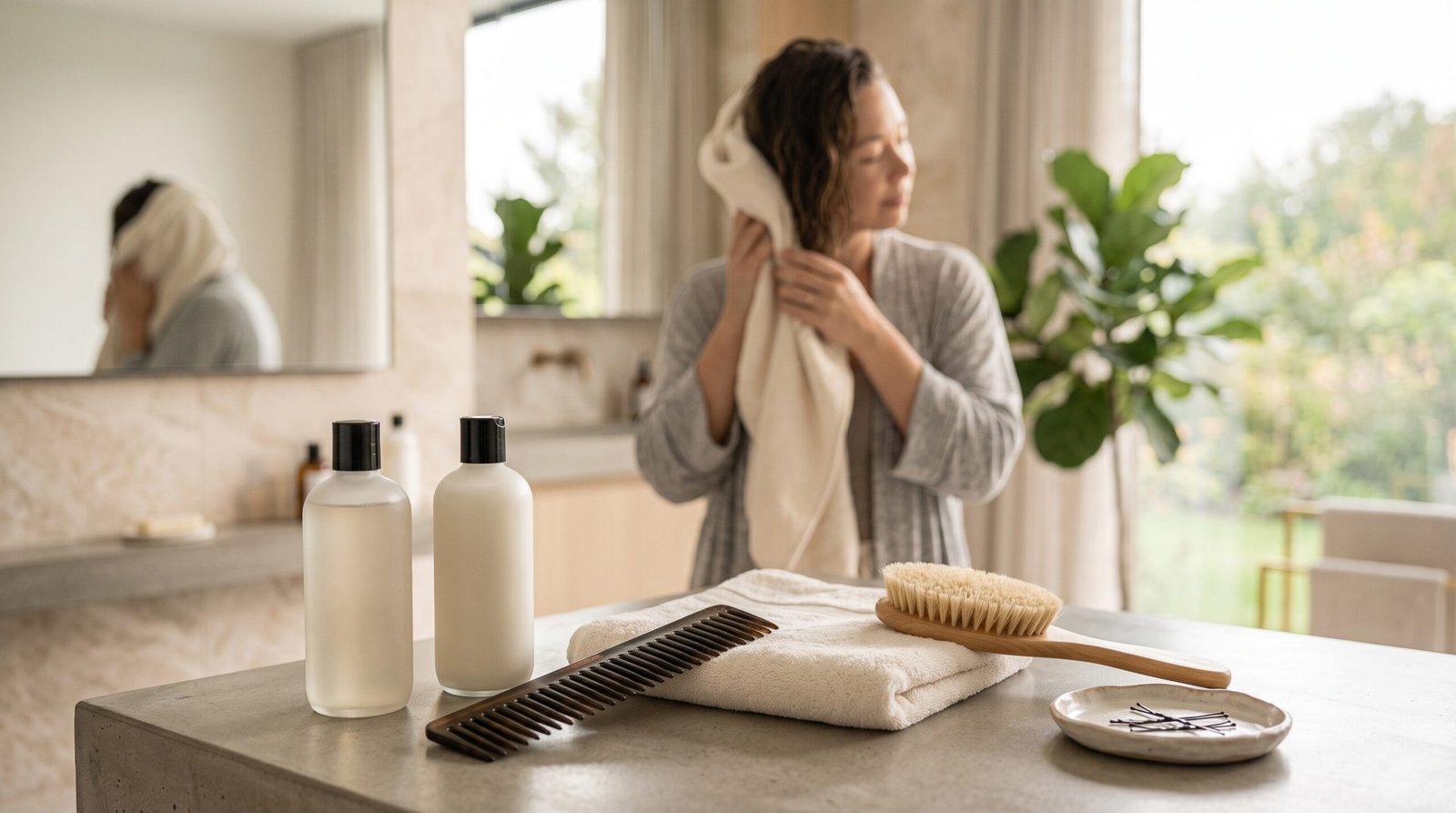
A Simple Wash-Day Routine
Once you understand how often should you wash your hair, keeping your wash-day routine simple can make hair care much easier.
You don’t need a ten-step process.
A simple routine can look like this:
Step 1: Wet Your Hair Thoroughly
Use comfortable water temperature and make sure your hair and scalp are completely saturated before applying shampoo.
Step 2: Apply Shampoo to the Scalp
Place shampoo primarily on the scalp and massage gently with your fingertips.
Focus on cleansing rather than aggressively scrubbing.
Step 3: Rinse Thoroughly
Make sure shampoo is completely rinsed from the scalp and hair.
Step 4: Apply Conditioner
Apply conditioner according to your hair type.
Fine or straight hair may need conditioner mainly toward the ends, while dry or curly hair may benefit from conditioning more of the length.
Step 5: Detangle Gently
Use an appropriate comb or detangling method for your hair type.
Avoid aggressively pulling through knots, especially while the hair is wet.
Step 6: Dry Carefully
Blot or gently squeeze out excess water instead of vigorously rubbing your hair with a towel.
If using heat, keep the temperature as low as practical.
How to Know You’ve Found the Right Washing Schedule
Your routine is probably working when:
- Your scalp feels clean and comfortable.
- Your roots aren’t excessively greasy.
- Your hair doesn’t feel constantly stripped or dry.
- You aren’t dealing with persistent buildup.
- Your hair remains manageable between washes.
- You aren’t constantly fighting itching or flaking.
The perfect routine doesn’t have to look like anyone else’s.
Your friend may wash every day.
Someone else may wash twice a week.
Someone with very dry, tightly coiled hair may go considerably longer.
None of those schedules is automatically “correct” for everyone.
Frequently Asked Questions
How often should you wash your hair if it gets oily quickly?
If your scalp becomes oily quickly, you may need to shampoo more frequently. The American Academy of Dermatology notes that people with straight hair and oily scalps may need daily shampooing.
Is it okay to wash your hair every day?
For some people, yes.
Daily washing isn’t automatically harmful. If you have an oily scalp and your hair tolerates frequent washing well, daily shampooing may be appropriate.
The key is choosing products suitable for your hair type and cleansing gently.
How often should you wash curly hair?
Curly hair often needs less frequent shampooing because it tends to be more prone to dryness.
The American Academy of Dermatology recommends washing curly or coily hair when needed rather than following a rigid daily schedule.
Should I wash my hair after every workout?
Not necessarily.
If your scalp becomes sweaty, oily, or uncomfortable after exercise, washing more frequently may help. If your workouts don’t leave your scalp particularly sweaty, you may not need to shampoo every time.
Can washing your hair too much make it dry?
Frequent washing can contribute to dryness for some hair types, particularly when combined with harsh products or excessive heat.
If your hair consistently feels dry or brittle, consider whether your shampoo, washing frequency, and styling routine need adjustment.
Is dry shampoo a replacement for washing?
No.
Dry shampoo can temporarily absorb oil and refresh the appearance of your hair, but it doesn’t replace cleansing the scalp.
Why does my scalp itch between washes?
An itchy scalp can have several causes, including dandruff, irritation, product buildup, or other scalp conditions.
If the itching persists, becomes severe, or is accompanied by redness or significant flaking, consider seeing a dermatologist.
Can I wash my hair less often to make it less oily?
Don’t assume that simply extending wash days will permanently reduce your scalp’s oil production.
Instead, choose a schedule based on how oily or uncomfortable your scalp becomes.
The Bottom Line
So, how often should you wash your hair?
There isn’t a magic number.
The best schedule depends on your scalp, hair texture, oil production, lifestyle, exercise routine, and the condition of your hair.
Some people need to wash daily.
Others may be perfectly comfortable washing a few times a week.
Curly, coily, thick, or very dry hair may need considerably less frequent shampooing, while fine or oily hair may need more frequent cleansing.
Instead of following rigid hair-care rules, pay attention to your own scalp.
If it becomes oily, sweaty, itchy, or uncomfortable, that’s useful information.
If your hair becomes excessively dry or brittle, that’s useful information too.
Start with the basics: shampoo your scalp gently, condition according to your hair type, handle wet hair carefully, and adjust your routine when your hair or scalp tells you something isn’t working.
You don’t need a complicated routine.
You need one that makes sense for your hair.
And sometimes, the best hair-care hack isn’t washing less or washing more.
It’s simply learning to recognize what your scalp actually needs.



Post Comment