

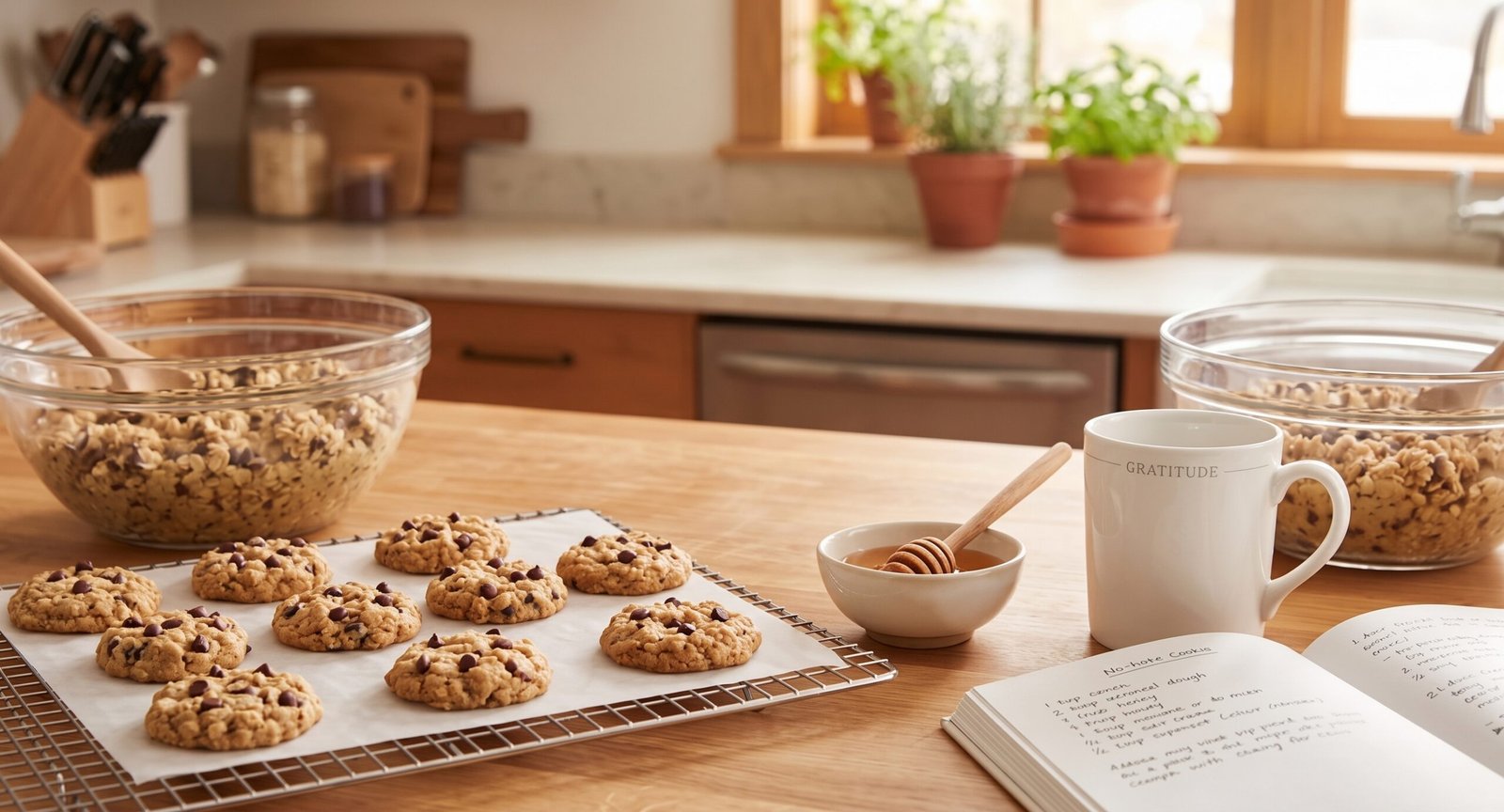
Gratitude is one of those simple things that can easily get overlooked.
We often think we need a major reason to feel thankful — a celebration, wonderful news, a special occasion, or something exciting happening in our lives.
But gratitude does not have to wait for a perfect moment.
Sometimes it begins with something incredibly ordinary.
A warm meal.
A quiet morning.
A cup of coffee.
A conversation with someone we love.
A safe place to sleep.
A homemade treat shared around the table.
These moments may not seem important enough to write down, remember, or stop and appreciate. Yet so much of everyday life is made up of moments exactly like these.
Gratitude can help us notice them.
It does not necessarily change our circumstances, but it can change the way we look at them. And sometimes, a small change in perspective can make an ordinary day feel very different.
In this article, we will look at five simple ways gratitude can become part of everyday life — including a small tradition that connects gratitude with food and faith.
And because gratitude and food naturally belong together, there is also a simple 5-Minute No-Bake Cookie recipe to enjoy at the end.
What Does Gratitude Really Mean?
Gratitude is more than simply saying “thank you.”
At its heart, gratitude is the intentional recognition of something good, valuable, meaningful, or helpful in our lives.
Sometimes that something is significant.
Other times, it is incredibly small.
You might be grateful for someone who supported you during a difficult season.
You might appreciate having a comfortable place to sleep.
You might be thankful for a meal you did not have to prepare yourself.
Or you might simply enjoy five quiet minutes with a cup of coffee before the rest of the house wakes up.
The important thing is not the size of the blessing.
It is the act of noticing it.
This is especially meaningful because our attention naturally tends to move toward problems.
One frustrating conversation can stay in our minds for hours.
One disappointment can overshadow several good things that happened during the same day.
One inconvenience can suddenly feel like the defining moment of an otherwise ordinary morning.
Gratitude gives our attention somewhere else to go.
It reminds us that even when something is difficult, it may not be the only thing happening.
5 Simple Ways Gratitude Can Change Everyday Life
1. Gratitude Helps You Notice What You Usually Overlook
One of the simplest ways gratitude can change everyday life is by helping you pay attention.
Many good things happen quietly.
Nobody announces that you should appreciate the warm sunlight coming through the window.
Nobody tells you to stop and notice that you have food in your kitchen.
There may not be a special occasion when someone checks on you, makes you laugh, or gives you a few moments of peace.
These things can easily disappear into the background of a busy day.
Practicing gratitude gives you a reason to notice them.
Try asking yourself:
“What is one good thing happening today that I might normally overlook?”
The answer does not have to be impressive.
Maybe your coffee tastes especially good this morning.
Maybe your child said something funny.
Maybe you finished a task that had been bothering you.
Maybe you had a peaceful conversation with someone you love.
Maybe you simply woke up to another morning.
The purpose is not to force yourself to feel happy.
It is to become more aware of what is already present.
2. Gratitude Helps You Appreciate the Present While Still Looking Ahead
Being grateful does not mean giving up on your goals.
You can appreciate what you have while still wanting something to change.
You can be thankful for your current home while hoping to move someday.
You can appreciate your job while working toward a different career.
You can be grateful for where you are in life while still dreaming about where you want to go.
These things can exist together.
The problem begins when the future becomes the only place where we allow ourselves to be happy.
“I’ll be happy when I have more money.”
“I’ll enjoy life when the house is finished.”
“I’ll relax when everything is organized.”
“I’ll appreciate this season when life gets easier.”
If we constantly postpone appreciation, we can miss the life happening right now.
Gratitude offers a different perspective:
I can work toward something better without believing that everything I have today is worthless.
That is a much healthier way to move forward.
3. Gratitude Can Give Ordinary Routines More Meaning
Most of life is made up of routines.
Making breakfast.
Getting ready for the day.
Preparing lunch.
Cleaning the kitchen.
Doing laundry.
Driving somewhere.
Preparing dinner.
Getting children ready for bed.
Because these things happen repeatedly, we can stop noticing them.
But gratitude can create small moments of awareness inside those routines.
Think about preparing a simple meal.
Instead of seeing only another task that needs to be completed, you might pause and recognize that you have ingredients available, a place to prepare them, and people with whom you can share the meal.
The routine has not changed.
Your awareness of it has.
This is one reason gratitude can be so practical.
You do not have to create an entirely new lifestyle.
You can simply bring more attention to the life you already have.
Try attaching gratitude to something you already do.
While making coffee, think of one thing you are looking forward to.
While preparing dinner, think about one person you appreciate.
Before going to bed, remember one moment from the day that made you smile.
The habit can take less than a minute.
4. Gratitude Can Strengthen the Way We Appreciate Other People
Gratitude is not only about things.
It is also about people.
Many of the things others do for us become so familiar that we stop noticing them.
Someone prepares a meal.
Someone checks on us.
Someone helps with a task.
Someone listens when we need to talk.
Someone remembers something important to us.
Someone makes a difficult day a little easier.
Because these actions may happen repeatedly, we can accidentally begin to treat them as automatic.
A simple expression of specific gratitude can change that.
Instead of saying only:
“Thanks for everything.”
try saying:
“Thank you for taking care of that today. It really helped me.”
Specific appreciation communicates something important:
I noticed.
That can mean a lot.
You can practice this by choosing one person each day and thinking about something specific you appreciate about them.
You do not always have to send a message or make a grand gesture.
Sometimes simply becoming more aware of the people who contribute to your life can change the way you relate to them.
5. Gratitude Can Give You Perspective During Difficult Days
This may be the most important thing to understand about gratitude.
Gratitude does not mean pretending everything is fine.
Some days really are difficult.
There may be disappointment, financial stress, family problems, uncertainty, grief, exhaustion, or situations you wish were completely different.
Telling someone to “just be grateful” can sometimes make them feel as though their pain is being ignored.
Healthy gratitude is different.
You can acknowledge that something hurts and still recognize something good.
You can be disappointed and grateful.
You can be tired and grateful.
You can be uncertain and grateful.
You can wish something were different while appreciating what is still good.
Instead of asking:
“How can I convince myself that everything is okay?”
try asking:
“What is still worth appreciating in the middle of this?”
Maybe the answer is a person.
Maybe it is a safe place to rest.
Maybe it is a meal.
Maybe it is one peaceful moment.
Maybe it is simply the strength to get through another day.
Gratitude does not erase difficult emotions.
It gives them some company.
A Curious Question: Why Do We Say “Grace” Before a Meal?
For many Christian families, gratitude and meals have long been connected through the tradition of saying grace.
The practice can look different from one household to another.
Some people say a traditional prayer.
Others offer a short sentence of thanks.
Some families hold hands around the table, while others quietly pray before beginning their meal.
The expression ‘saying grace’ has a long history. In English, grace can refer to a short prayer said before a meal, and the word comes from the Latin gratia, associated with ideas such as favor, gratitude, and thanks.
Over time, “saying grace” became closely associated with giving thanks before a meal.
And there is something beautiful about that tradition.
A meal can easily become another part of a busy schedule.
We prepare the food, sit down, eat, clean up, and move on to whatever comes next.
A short prayer creates a pause.
For a few moments, we stop thinking about what needs to happen next and recognize what is already in front of us.
Food.
Provision.
People.
Time together.
A simple prayer before eating does not have to be long to be meaningful.
Sometimes one sincere sentence is enough:
“Thank You, God, for this food and for the people gathered around this table.”
That small pause can turn an ordinary meal into an intentional moment of gratitude.
Gratitude Does Not Need a Complicated Routine
One of the best things about gratitude is how simple it can be.
You do not need a special notebook.
You do not need a perfectly quiet room.
You do not need to spend an hour writing down everything you appreciate.
Sometimes a single sentence is enough.
“Thank You for this meal.”
“Thank You for my family.”
“Thank You for helping me through today.”
“Thank You for another morning.”
The important part is making the practice intentional.
You can keep a gratitude journal if you enjoy writing.
You can pray.
You can share one thing you are thankful for at dinner.
Or you can simply pause during the day and notice something good.
There is no single correct method.
The best method is one that feels genuine enough for you to continue.
A Sweet Way to Practice Gratitude
Because gratitude can naturally connect with meals, family, and sharing something homemade, I wanted to include a recipe that follows the same philosophy as this article:
simple, comforting, and easy enough for everyday life.
These 5-Minute No-Bake Cookies require only a handful of basic ingredients and do not require an oven.
They can be made as a quick homemade snack, an easy dessert, or something sweet to share with family and friends.
They can also be a fun little recipe to prepare with children, especially because there is no complicated baking process.

5-Minute No-Bake Cookies
Ingredients
- 1 cup rolled oats
- 1/2 cup creamy peanut butter
- 1/3 cup honey or maple syrup
- A small pinch of sea salt
- 1/3 cup chocolate chips, optional
- 1/2 teaspoon vanilla extract, optional
- 1 tablespoon shredded coconut, optional
The first four ingredients make up the basic recipe.
The remaining ingredients allow you to personalize the flavor.
Chocolate chips add sweetness and texture.
Vanilla gives the cookies a little more depth.
Shredded coconut adds texture and a subtle coconut flavor.
You can also experiment with cinnamon or dried fruit.
How to Make the No-Bake Cookies
1. Combine the Main Ingredients
Add the rolled oats, peanut butter, honey or maple syrup, and sea salt to a medium mixing bowl.
Stir until the ingredients are evenly combined.
The mixture should become thick and sticky as the peanut butter and sweetener coat the oats.
If it looks too dry, add a small amount of peanut butter or honey.
If it seems excessively sticky, add a little more rolled oats.
2. Add Your Extras
If you are using chocolate chips, vanilla, shredded coconut, cinnamon, or another optional ingredient, add it now.
Fold everything together gently.
This is where the recipe becomes your own.
3. Shape the Cookies
Use a tablespoon to scoop portions of the mixture.
Shape each portion into a small ball or gently flatten it into a cookie shape.
If the mixture sticks to your hands, lightly dampen your hands with water.
4. Chill
Place the cookies on a plate or small tray lined with parchment paper.
Refrigerate for at least five minutes.
Chilling helps the cookies become firmer and easier to handle.
For a firmer texture, you can leave them refrigerated for longer.
5. Enjoy
Once chilled, the cookies are ready to eat.
They should have a soft, chewy texture with a satisfying combination of oats and peanut butter.
Serve them as a quick snack, a simple dessert, or alongside coffee or tea.
Easy Ways to Customize the Cookies
One of the best things about a simple no-bake recipe is that you can adapt it to your preferences.
Add Chocolate
Mini chocolate chips work especially well because they distribute easily throughout the mixture.
For a less sweet version, try dark chocolate chips.
Add Coconut
Unsweetened shredded coconut adds texture without making the cookies overly sweet.
Start with a tablespoon and adjust according to your taste.
Add Cinnamon
A small amount of cinnamon can add warmth and make the cookies feel especially cozy.
Try Another Nut Butter
If you prefer almond butter, you can experiment with it in place of peanut butter.
Because different nut butters have different consistencies, you may need to slightly adjust the amount of oats or sweetener.
Add Dried Fruit
Chopped raisins, dried cranberries, or dates can add sweetness and a chewy texture.
Keep the amount moderate so the mixture remains easy to shape.
Why Simple Recipes Can Become Meaningful
There is something special about recipes that do not require a long shopping list or complicated techniques.
They are often the recipes we return to.
If you enjoy simple homemade desserts, you may also want to try our easy Yogurt Cake recipe.
Maybe you make these cookies on a quiet Sunday afternoon.
Maybe your children help mix the ingredients.
Maybe you prepare them before friends arrive.
Maybe they become a quick treat you make when you want something sweet but do not want to turn on the oven.
A recipe can begin as nothing more than ingredients and instructions.
Over time, it can become connected to memories.
That is one of the reasons food and gratitude fit together so naturally.
We do not only remember what we ate.
We remember where we were, who was there, and how the moment felt.

Gratitude Around the Table
Think about everything that has to happen before a meal reaches your table.
Ingredients have to be grown, harvested, transported, purchased, prepared, and cooked.
There are people involved at every stage.
Farmers grow the food.
Workers harvest and process it.
Drivers transport it.
Grocery store employees stock it.
Someone prepares it in your kitchen.
By the time you sit down to eat, there is an entire story behind the meal.
Thinking about that story can make an ordinary meal feel different.
It does not mean every meal needs to become a serious ceremony.
Sometimes a few seconds of appreciation are enough.
You can simply look at the food in front of you and think:
“I am thankful to have this.”
And if you are sharing the meal with other people, there is even more to appreciate.
The food is only one part of the experience.
The people around the table matter too.
Bringing Gratitude Into Everyday Life
Gratitude does not have to stay at the dinner table.
You can practice noticing good things throughout the day.
In the morning
Before getting out of bed, think of one thing you are thankful for.
With your coffee
Instead of rushing through the first few minutes of the morning, take a moment to actually enjoy them.
When someone helps you
Notice their kindness instead of immediately moving on to the next task.
When something goes well
Allow yourself to recognize it.
You do not have to minimize a good moment simply because something else is difficult.
At night
Think of one moment from the day that made you smile.
These habits are small enough to fit into real life.
And that is important.
A gratitude practice does not need to become another responsibility on your already-full list.
It should create a moment of awareness, not another source of pressure.
Gratitude During Difficult Seasons
There will be days when gratitude feels easy.
There will also be days when it feels difficult.
On those days, you do not have to search for a long list of blessings.
Start with one thing.
Maybe you are grateful for someone who supports you.
Maybe you appreciate having a warm place to rest.
Maybe you are thankful for a meal.
Maybe you are grateful for one peaceful conversation.
Maybe all you can honestly say is:
“I am thankful that I made it through today.”
That is enough.
Gratitude does not require you to deny sadness, disappointment, or fear.
It can simply help you remember that those emotions are not necessarily the whole story.
There can be difficulty and gratitude in the same day.
There can be unanswered questions and thankfulness.
There can be pain and still be moments worth holding onto.
Gratitude and Faith
For Christians, gratitude has an even deeper meaning.
If you enjoy starting your day with God, you may also enjoy our guide to Morning Prayer.
The Bible repeatedly encourages believers to give thanks.
1 Thessalonians 5:18 says:
“Give thanks in all circumstances; for this is God’s will for you in Christ Jesus.”
The verse does not say that every circumstance is good.
Rather, it calls believers toward thankfulness in all circumstances.
That distinction matters.
Christian gratitude does not require us to call something painful “good.”
Instead, it can remind us to recognize God’s presence, goodness, provision, and faithfulness even when circumstances are difficult.
Psalm 107:1 also begins with an invitation to give thanks to the Lord because He is good and His steadfast love endures.
For a Christian, gratitude can therefore become more than a positive-thinking exercise.
It can become an expression of trust.
A simple prayer might be:
“God, help me notice the blessings I often overlook. Thank You for the people, opportunities, provision, and everyday moments You have placed in my life. Help me remain grateful without ignoring the things that need to change. Give me wisdom and faith for whatever comes next. Amen.”
A Simple Gratitude Practice to Start Today
If you want to make gratitude part of your routine, keep it simple.
Tonight, before you go to bed, ask yourself three questions:
What is one thing I am thankful for?
Who is one person I appreciate?
What is one ordinary moment I do not want to take for granted?
Write down your answers or simply think about them.
Tomorrow, do it again.
You do not need a perfect streak.
You do not need to create an elaborate journal.
You simply need to pause long enough to notice.
And if you want to connect the habit with something you already do, try practicing gratitude before your next meal.
Pause.
Look at what is in front of you.
Think about how it got there.
Think about the people sharing it with you.
Then give thanks.
The Sweetness of Gratitude
Gratitude is not about having a perfect life.
It is about learning to notice the good that exists within the life you already have.
A warm meal can be a blessing.
A conversation can be a blessing.
A quiet morning can be a blessing.
A cup of coffee can become a small reminder to slow down.
A homemade cookie can become part of a memory.
A few minutes around the kitchen table can become something you remember years later.
The next time you sit down for a meal, take a few seconds before reaching for your fork.
Think of one thing you are thankful for.
It does not have to be big.
It does not have to be impressive.
It simply has to be real.
Maybe that is the secret ingredient after all.
Not something complicated.
Not something expensive.
Just a grateful heart learning to notice the sweetness that is already there.