

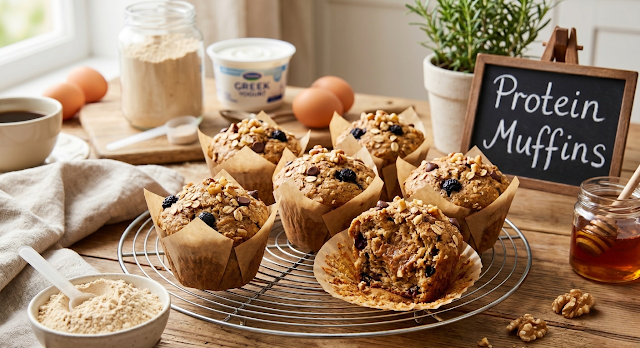
If you love muffins but want something a little more filling than a traditional bakery-style muffin, these Healthy Protein Muffins are an easy option for breakfast, meal prep, or an afternoon snack.
They combine oats, protein powder, Greek yogurt, eggs, and a few simple ingredients to create soft muffins with a satisfying texture. You can make them with blueberries for a fresh, fruity version or chocolate chips when you want something a little more indulgent.
The trick with protein muffins is balance.
Protein powder can make baked goods dry or dense when too much is used or when the batter does not have enough moisture. Greek yogurt, eggs, and the right amount of milk help create a softer crumb, while careful mixing and baking keep the muffins from becoming rubbery.
These muffins are designed to be simple enough for a weekday morning while still giving you plenty of room to customize them.
Why These Healthy Protein Muffins Work
A good protein muffin should still feel like a muffin.
It should have a soft interior, lightly golden edges, and enough moisture to keep it enjoyable after cooling. Adding protein powder alone does not guarantee that result. In fact, protein powder can make baked goods drier if the rest of the recipe is not balanced properly.
That is why this recipe combines protein powder with Greek yogurt, eggs, oats, and milk.
Greek yogurt contributes moisture and richness, while eggs help provide structure. Oats give the muffins a hearty texture, and the protein powder increases the protein content without requiring a complicated ingredient list.
The result is a practical breakfast muffin that can be prepared ahead and customized with your favorite mix-ins.
Healthy Protein Muffins Recipe
Ingredients
For the muffins:
- 1½ cups oat flour
- ½ cup protein powder
- 1 cup plain Greek yogurt
- 2 large eggs
- ½ cup unsweetened almond milk
- ¼ cup pure maple syrup or honey
- 2 teaspoons baking powder
- ½ teaspoon ground cinnamon
- 1 teaspoon vanilla extract
- ¼ teaspoon salt
Optional mix-ins:
- ½ to 1 cup fresh or frozen blueberries
- ½ cup chocolate chips
- Chopped walnuts or pecans
- A small handful of dried cranberries
Before You Start
If you do not have oat flour, you can make your own by processing rolled oats until they become a fine flour.
The texture will be more consistent if the oats are ground fairly finely rather than left in large pieces.
Protein powders vary significantly in how they absorb liquid, so the batter should be evaluated by texture rather than assuming every brand will behave exactly the same way.
The finished batter should be thick and scoopable, but not dry or crumbly.
How to Make Healthy Protein Muffins
1. Prepare the Oven and Muffin Pan
Preheat the oven to 350°F (175°C).
Line a standard 12-cup muffin pan with paper liners or lightly grease the cups.
Preparing the pan before mixing the batter keeps the process simple and prevents the batter from sitting around while you prepare the oven.
These healthy protein muffins are easiest to make when all of your ingredients are prepared before you start mixing.
2. Combine the Wet Ingredients
In a large mixing bowl, whisk together the Greek yogurt, eggs, almond milk, maple syrup or honey, and vanilla extract.
Mix until the ingredients are evenly combined.
The mixture does not need to be whipped or beaten for a long time.
A smooth mixture is all you need.
3. Add the Dry Ingredients
Add the oat flour, protein powder, baking powder, cinnamon, and salt.
Stir gently until the dry ingredients are incorporated.
Do not continue mixing once the batter is evenly combined.
Protein muffins can become dense or rubbery when the batter is overworked, so gentle mixing is important.
If the batter appears unusually thick or dry because of the protein powder you are using, add a small splash of almond milk and mix gently.
Add only a little at a time.

4. Add Your Mix-Ins
If you are using blueberries, chocolate chips, nuts, or another mix-in, fold them into the batter gently.
For frozen blueberries, there is no need to thaw them first.
Fold just until they are distributed throughout the batter.
You can also reserve a few blueberries or chocolate chips to place on top before baking.
5. Fill the Muffin Cups
Divide the batter evenly among the 12 muffin cups.
Fill each cup roughly two-thirds to three-quarters full.
Try to distribute the batter evenly so the muffins finish baking at approximately the same time.
If some cups have considerably more batter than others, the smaller muffins may become dry before the larger ones are fully baked.
6. Bake Until Just Done
Place the muffin pan in the preheated oven.
Bake for approximately 18–22 minutes.
Start checking toward the lower end of the baking range because ovens vary.
Insert a toothpick into the center of one muffin.
It should come out clean or with a few moist crumbs, but there should not be wet batter.
Avoid leaving the muffins in the oven longer than necessary.
Overbaking is one of the easiest ways to turn a soft protein muffin into a dry one.
7. Cool Before Serving
Allow the muffins to cool in the pan for about 5–10 minutes.
Then transfer them to a wire rack.
The interior continues to set as the muffins cool, so cutting into them immediately can give you a different impression of the final texture.
Once cooled, they are ready to enjoy.
7 Easy Tips for Moist Protein Muffins
1. Choose Your Protein Powder Carefully
Not every protein powder behaves the same way in baking.
Whey, casein, and plant-based powders can have different effects on moisture and texture.
Some protein powders absorb more liquid than others, which means the same recipe can produce a thicker batter with one brand and a softer batter with another.
For that reason, do not automatically add extra protein powder simply because you want a higher-protein muffin.
More is not always better for texture.
If your batter looks dry and difficult to scoop, a small amount of additional milk can help bring it back to the right consistency.
2. Use Greek Yogurt for Moisture
Greek yogurt is one of the most useful ingredients in this recipe.
It adds moisture and richness while also contributing protein.
The yogurt also gives the muffins a slightly tender texture that helps balance the potentially drying effect of protein powder.
Plain Greek yogurt works best for the base recipe because it allows you to control the sweetness yourself.
You can use a flavored yogurt for a variation, but remember that it may contain additional sugar and flavoring.
3. Do Not Overmix the Batter
This tip is simple but important.
Once the dry ingredients have been incorporated, stop mixing.
There is no need to beat the batter until it is perfectly smooth.
A few small lumps are generally preferable to an overworked batter.
Gentle mixing helps keep the muffins tender instead of dense and chewy.
4. Pay Attention to Batter Consistency
The batter should be thick enough to scoop but moist enough to spread slightly in the muffin cup.
If it looks dry, crumbly, or unusually stiff, the protein powder may have absorbed more liquid than expected.
Add a small splash of almond milk and gently stir.
Do not pour in a large amount at once.
Adding liquid gradually gives you much more control over the final texture.
5. Do Not Overbake
Protein powder and oats can both contribute to a drier texture when baked for too long.
That is why the 18–22 minute range should be treated as a guide rather than an absolute rule.
Start checking early.
The muffins are ready when the tops look set and a toothpick inserted into the center comes out clean or with a few moist crumbs.
For general food-safety guidance when working with eggs and other ingredients, you can also refer to the USDA Food Safety and Inspection Service.
If the toothpick is completely dry and the muffins have been in the oven for significantly longer than necessary, they may already be losing moisture.
6. Let Them Cool Properly
It can be tempting to eat a muffin straight from the oven.
But allowing it to cool for several minutes helps the crumb finish setting.
Leave the muffins in the pan for approximately 5–10 minutes, then move them to a wire rack.
Once they are cool enough to handle, the texture will be easier to evaluate.
7. Choose Moist Mix-Ins
Blueberries are an excellent choice when you want a naturally fruity muffin.
Chocolate chips provide a richer dessert-like flavor.
Mashed banana or applesauce can also be incorporated into variations when you want additional moisture and natural sweetness.
If you change the recipe substantially, however, remember that adding wet ingredients can change the baking time and batter consistency.
For the most predictable result, start with the base recipe before experimenting.
Blueberry Protein Muffins
Blueberries are one of the easiest ways to customize these muffins.
Fresh blueberries can be folded directly into the batter.
Frozen blueberries can also work well.
Do not overmix them because the berries can release juice and turn the batter purple.
For a bakery-style appearance, reserve a few blueberries and gently press them onto the tops before baking.
The result is a lightly sweet muffin with bursts of fruit throughout.
Chocolate Chip Protein Muffins
For a more indulgent version, replace the blueberries with chocolate chips.
Mini chocolate chips work particularly well because they distribute throughout the batter without creating large pockets of chocolate.
You can use dark, semi-sweet, or milk chocolate depending on your preference.
A small amount goes a long way, so you do not need to cover the entire muffin with chocolate.
How to Make Homemade Oat Flour
If oat flour is not a regular item in your pantry, making it at home is simple.
Add rolled oats to a food processor or high-powered blender.
Process until the oats become a fine, flour-like powder.
Stop occasionally and check the texture.
Large pieces of oats can absorb liquid differently from finely ground oat flour, which can affect the consistency of the batter.
Once the oats are finely ground, measure the amount needed for the recipe.
Can You Make These Muffins Without Protein Powder?
You can make an oat-and-yogurt muffin without protein powder, but it will no longer have the same protein profile as this recipe.
Protein powder is one of the main ingredients responsible for increasing the protein content.
If you remove it, replacing it with the same volume of oat flour will change the texture and nutritional composition.
For that reason, I would treat a no-protein-powder version as a separate recipe rather than simply removing the protein powder from this one.
How to Store Protein Muffins
Allow the muffins to cool completely before storing them.
Place them in an airtight container.
For short-term storage, keep them at room temperature if your environment and ingredients allow it, or refrigerate them if you prefer.
Refrigeration can make muffins feel firmer, especially when they contain oats and protein powder.
If that happens, let one sit at room temperature for a little while before eating.
You can also warm it briefly if you prefer a softer texture.
For longer storage, freeze the cooled muffins in a freezer-safe container or bag.
Thaw them individually when needed.
Can You Freeze Healthy Protein Muffins?
Yes.
Freezing is particularly convenient if you make a full batch and do not expect to eat all 12 muffins within a few days.
Allow the muffins to cool completely first.
Wrap or store them in a freezer-safe container, separating layers if necessary.
When you want one, thaw it in the refrigerator or at room temperature.
A short warm-up can help restore some of the softness that muffins can lose after refrigeration or freezing.
How to Serve Them
These muffins are flexible enough for several occasions.
Serve one with:
- Greek yogurt and fresh berries
- A piece of fruit
- Coffee or tea
- A smoothie
- Nut butter
- A simple breakfast plate
They also work well as a grab-and-go snack.
For another easy breakfast idea, you can pair them with the creamy components of our Hot Honey Cottage Cheese Sweet Potato Beef Bowl: 5 Tips, although the two recipes offer very different flavor profiles.
If you prefer a dessert-style recipe for later in the day, our Yogurt Cake: Easy, Moist & Delicious Homemade Recipe is another simple baked option.
Common Questions
Why are my protein muffins dry?
The most common possibilities are too much protein powder, insufficient liquid, overmixing, or overbaking.
Protein powders absorb liquid differently, so pay attention to the batter rather than following a rigid visual expectation.
If the batter is extremely thick, add a small amount of milk before baking.
Why did my protein muffins become rubbery?
Overmixing and overbaking can contribute to a rubbery texture.
Once the dry ingredients are incorporated, stop stirring.
Also begin checking the muffins before the maximum baking time is reached.
Can I use whey protein?
Yes, but results can vary by product.
Some whey-based powders can produce a drier texture when baked, so monitor the batter and avoid overbaking.
Can I use plant-based protein powder?
Yes.
Plant-based protein powders can work, although their absorption and texture can differ from whey or casein.
You may need a small adjustment to the liquid depending on the specific product.
Can I use almond flour instead of oat flour?
You can experiment with almond flour, but it is not a one-to-one substitution in every recipe.
Almond flour contains considerably more fat and behaves differently from oat flour, so changing the flour can alter the structure, moisture, and baking time.
For the most reliable result, use oat flour for the first batch.
A Simple Protein Muffin Worth Repeating
The best healthy muffin is not necessarily the one with the longest ingredient list or the highest amount of protein powder.
These healthy protein muffins focus on the balance between protein, moisture, and a texture you actually want to eat.
It is the one you actually enjoy eating.
These muffins focus on that balance.
Greek yogurt provides moisture and protein.
Eggs help create structure.
Oats give the muffins their hearty base.
Protein powder adds another protein source.
And blueberries or chocolate chips allow you to choose the flavor you want.
The seven tips are just as important as the ingredient list because protein baking requires a little more attention to moisture and texture than a traditional muffin recipe.
Keep the batter moist but scoopable.
Mix gently.
Watch the oven.
And most importantly, do not overbake.
Once you find the protein powder and mix-ins you like, this recipe can become an easy addition to your breakfast or meal-prep routine.