Keeping a home organized can feel impossible when one person is doing most of the work.
Between school bags, shoes, laundry, toys, dishes, paperwork, groceries, and everything else that happens during a normal week, clutter can return almost as quickly as you clear it.
But a family home does not have to stay organized because one person constantly picks everything up.
A better approach is to create simple systems that make it easier for everyone to know where things belong and what they can do to help.
Learning how to organize your home as a family is less about creating a picture-perfect house and more about making everyday life easier. When routines are predictable and responsibilities are shared, maintaining the home can become much less overwhelming.
The American Academy of Pediatrics notes that regular, predictable family routines can help organize daily life, while age-appropriate household responsibilities can help children develop cooperation and practical life skills.
Here are 10 simple systems that can help your family create a home that feels more manageable without turning organization into another source of stress.
1. Give Everything a Home
One of the simplest rules of family organization is that frequently used items should have a predictable place.
This sounds obvious, but many homes become cluttered because objects technically have a place somewhere, but that place is inconvenient or unclear.
Think about the things your family uses every day:
- Shoes
- Backpacks
- Jackets
- School papers
- Toys
- Chargers
- Keys
- Water bottles
- Sports equipment
Instead of creating complicated storage systems, choose locations that make sense based on how your family actually moves through the house.
For example, backpacks might belong on hooks near the entrance rather than in a bedroom. Shoes might have a basket or shelf close to the door. School papers could have one designated folder for each child.
The goal is not perfect storage.
The goal is making the easiest choice the organized choice.
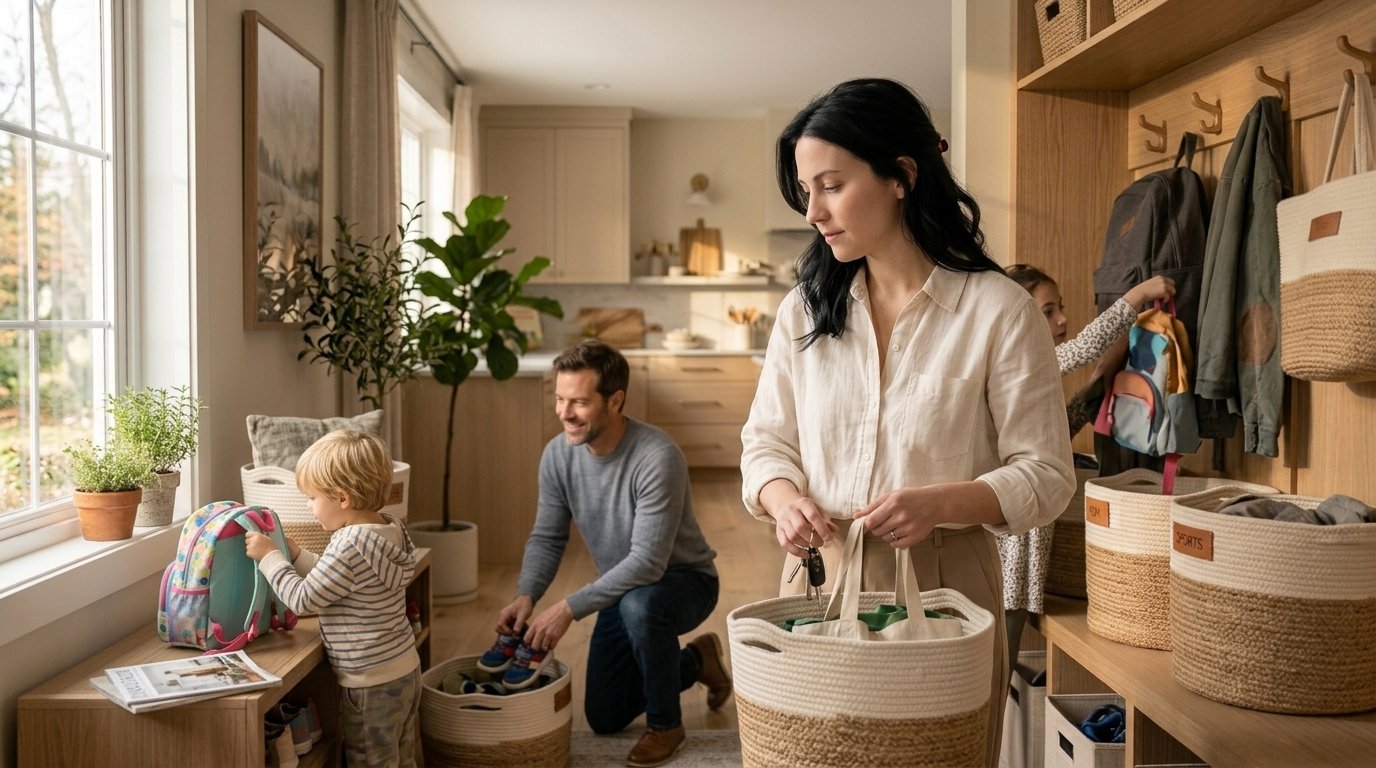
2. Create a Family Drop Zone
The entrance of the home can become one of the biggest sources of everyday clutter.
A backpack lands on the floor. Shoes stay by the door. A jacket ends up on a chair. Someone puts an envelope on the counter and forgets about it.
A simple family drop zone can prevent this chain reaction.
Depending on your space, you might use:
- Wall hooks
- A small bench
- Baskets
- Shoe storage
- A mail tray
- A basket for school papers
- Hooks labeled for each family member
Keep the system simple enough that children can use it without constant assistance.
A drop zone works best when it reflects your family’s real routine instead of an idealized version of it.
3. Give Each Family Member a Few Responsibilities
Family organization becomes much easier when household responsibilities do not belong to one person.
Children do not need to take over household work, but they can gradually learn to contribute in age-appropriate ways.
The American Academy of Pediatrics recommends introducing responsibilities gradually and keeping expectations realistic. Younger children can help with simple tasks such as putting away toys, while older children can take on more involved responsibilities.
The important part is not creating a huge chore list.
Start with a few consistent responsibilities.
For example:
Young children
- Put toys away
- Place dirty clothes in the hamper
- Help clear the table
- Put books back on the shelf
School-age children
- Make their bed
- Put away laundry
- Help unload groceries
- Vacuum a small area
- Help with simple meal preparation
Older children and teens
- Fold and put away laundry
- Help clean shared spaces
- Load or unload the dishwasher
- Prepare simple meals
- Help with household maintenance
The goal is to teach contribution, not demand perfection.
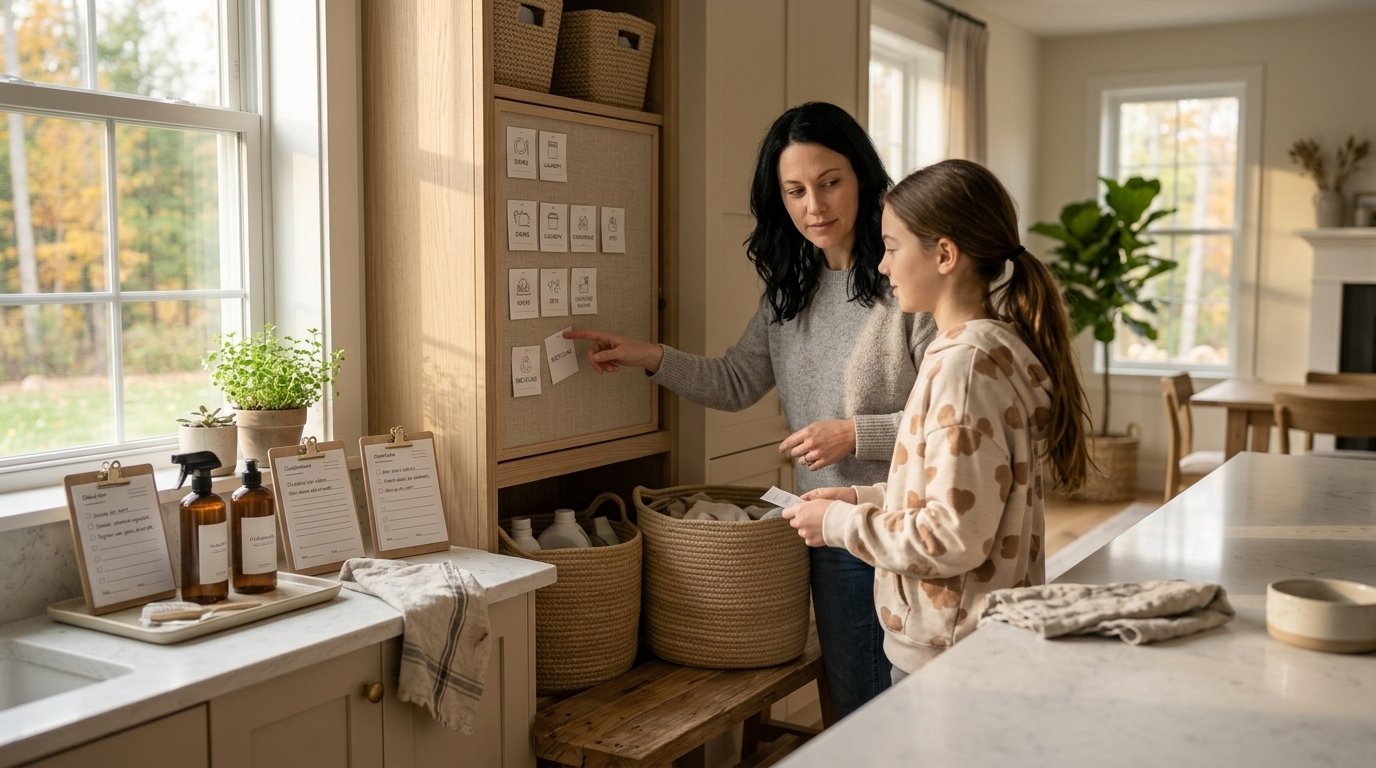
4. Use a Simple Family Chore System
Once everyone has responsibilities, make them visible.
A family chore chart does not need to be complicated.
You could use a whiteboard, printed checklist, magnetic board, or even a shared digital list.
Keep the system easy to understand.
For example:
| Task | Who | When |
|---|---|---|
| Put toys away | Child | Evening |
| Empty small trash cans | Child | Saturday |
| Laundry | Teen | Wednesday |
| Dishwasher | Parent/Teen | Daily |
| Family room reset | Everyone | Evening |
The American Academy of Pediatrics notes that visual chore charts can act as reminders and help children understand expectations.
Try not to turn the chart into a punishment system.
It is simply a visual reminder that maintaining a home is something the family does together.
5. Create a 10-Minute Family Reset
You do not need to spend an entire Saturday cleaning the house.
A short family reset can make a surprising difference.
Choose a consistent time, such as before dinner or before bedtime, and give everyone about 10 minutes to return things to their proper places.
One person might collect toys.
Another might straighten the living room.
Someone else could put shoes away or clear the kitchen counter.
If everyone participates, even a small reset can make the house feel significantly better.
The purpose is not deep cleaning.
It is simply preventing small messes from becoming overwhelming ones.
You can even make the reset part of the family’s normal evening routine. Regular routines can make daily responsibilities more predictable and easier to remember.
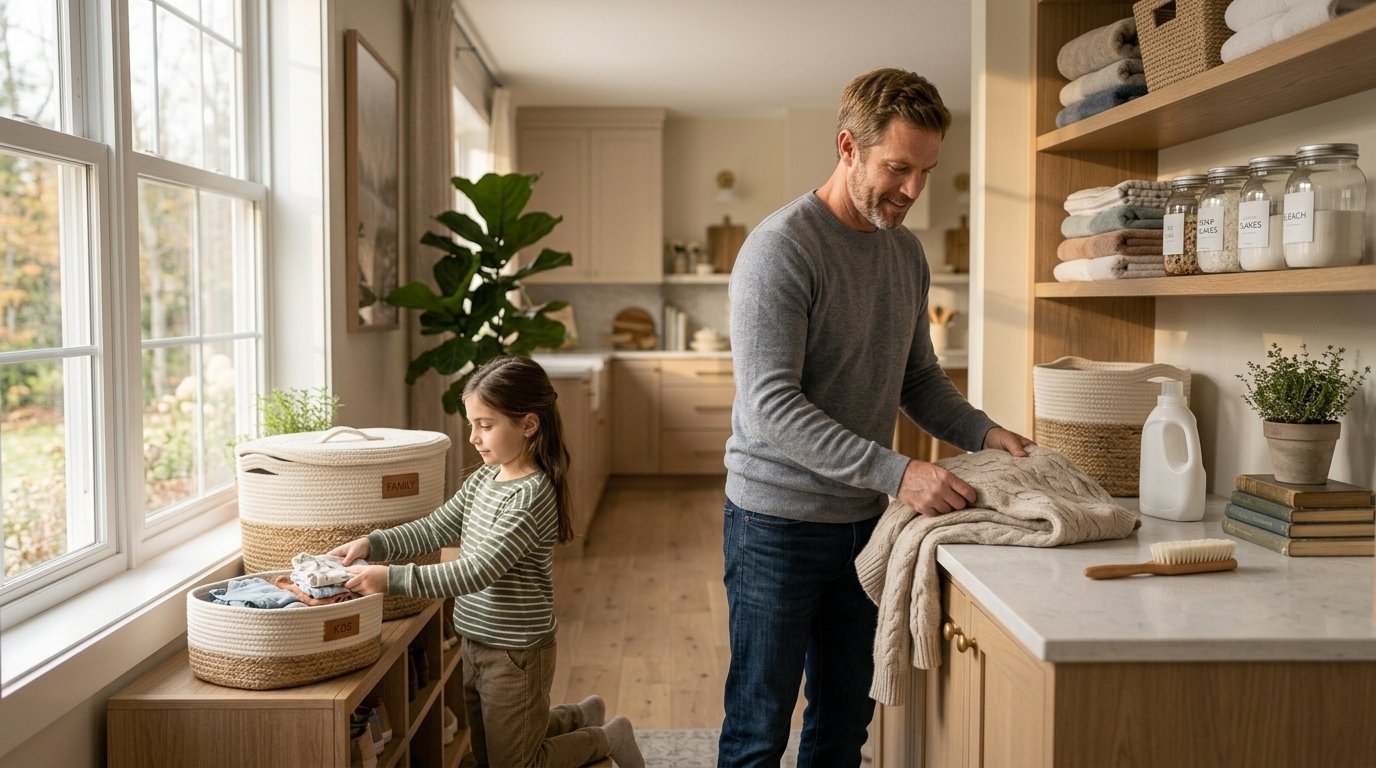
6. Make Laundry Easier to Maintain
Laundry can become a never-ending cycle in a busy household.
Instead of trying to create a complicated laundry schedule, simplify the system.
Start by giving everyone a place for dirty clothes.
A hamper in each bedroom can work well, but a shared laundry basket can also be effective if that fits your home better.
Then decide what happens after clothes are washed.
For example:
Wash → Dry → Fold → Put Away
The last step is often the one that gets forgotten.
If possible, encourage older children to put away their own clean clothes. Younger children can help match socks or put simple items into drawers.
You do not need to fold every item perfectly.
The goal is to create a system that keeps clean laundry moving instead of creating permanent piles.
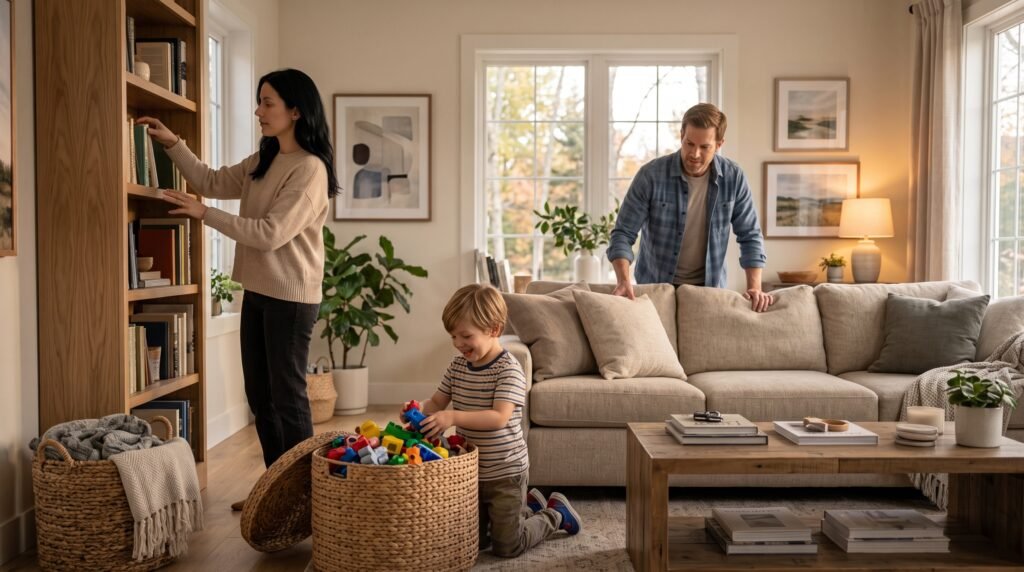
7. Create a Family Toy and Clutter Rule
Toys can quickly take over a home, especially when children have many different types of toys.
Instead of constantly telling children to clean up, create a simple rule for what happens when they are finished playing.
One useful system is:
Play → Finish → Sort → Put Away
Use clearly defined categories when possible.
For example:
- Building toys
- Dolls and stuffed animals
- Art supplies
- Puzzles and games
- Books
- Outdoor toys
Storage does not need to look perfect.
Open baskets can sometimes be easier for young children than drawers or containers with complicated lids.
You can also periodically remove broken, incomplete, or forgotten toys.
The goal is not to make children own fewer things simply for the sake of minimalism.
It is to make the things they already have easier to use and put away.
8. Create a Shared Family Calendar
Some household clutter is not physical.
It is mental.
Appointments, school events, practices, birthdays, activities, grocery needs, and deadlines can all compete for attention.
A shared family calendar can help everyone see what is happening.
You might use:
- A wall calendar
- A refrigerator calendar
- A family planner
- A shared digital calendar
Choose one main system rather than keeping important information scattered across several places.
At the beginning of each week, spend a few minutes reviewing what is coming.
Ask:
- Who needs to be somewhere?
- What meals need planning?
- Are there school events?
- Does anyone need special equipment or supplies?
- What household tasks need attention?
This small weekly check can prevent many last-minute surprises.
9. Organize the Kitchen Around How Your Family Uses It
The kitchen often becomes the center of family life, so organization here can have an especially noticeable impact.
Place frequently used items where family members can reach them safely.
For example, children might have an accessible area for:
- Cups
- Plates
- Snack containers
- Lunch supplies
- Water bottles
Keep adult-only or potentially hazardous items out of children’s reach.
You can also create a simple snack area with foods that children are allowed to choose independently when appropriate.
The purpose is not to give children complete access to the kitchen.
It is to encourage age-appropriate independence while making everyday routines easier.
Family meals and consistent routines are also part of the broader structure that can help organize daily family life.
10. Have a Weekly Family Organization Check-In
Your organization system will eventually stop working perfectly.
That is normal.
Children grow. School schedules change. Activities change. Seasons change. Your family’s needs change.
Instead of assuming the system has failed, review it together.
Once a week or once a month, ask:
What’s working?
What’s frustrating?
What keeps getting left out?
What could be easier?
Maybe the backpack hooks are too high.
Maybe the chore chart has too many tasks.
Maybe the laundry system needs to change.
Maybe the toy storage is no longer appropriate for your children’s ages.
A good organization system should evolve with your family.
Why Family Organization Works Better Than Mom Doing Everything
It can sometimes seem faster to do everything yourself.
And honestly, there will be moments when it is.
You can probably put away the toys faster than a five-year-old. You may fold laundry faster than your teenager. You may be able to clean the kitchen without stopping to explain every step.
But if one person always does everything, the family becomes dependent on that person to keep the home functioning.
Teaching children to contribute takes patience at first.
The American Academy of Pediatrics emphasizes that household responsibilities can help children learn cooperation and practical skills, and that expectations should increase gradually as children grow.
That makes family organization about more than having a clean house.
It becomes an opportunity to teach responsibility and independence.
Don’t Aim for a Perfectly Organized Home
One of the biggest mistakes families can make is creating an organization system that looks beautiful but is impossible to maintain.
A complicated labeling system may look wonderful on social media but become frustrating in real life.
A family-friendly system should be:
- Easy to understand
- Easy to access
- Easy to maintain
- Flexible
- Appropriate for the people using it
If a basket works better than a perfectly arranged shelf, use the basket.
If your family needs a five-minute reset instead of a long cleaning session, do the five-minute reset.
If everyone cannot keep up with a complicated chore chart, simplify it.
The best system is the one your family can actually continue using.
How to Organize Your Home as a Family Without Overwhelming Everyone
If your house currently feels chaotic, do not try to fix every room in one weekend.
Learning how to organize your home as a family does not mean creating a complicated system for every room. The goal is to make everyday tasks easier for everyone.
Start with one problem.
Maybe the entryway is always messy.
Maybe laundry never gets put away.
Maybe toys are everywhere.
Maybe school papers are constantly disappearing.
Choose one of those problems and create one simple system for it.
Once that system becomes familiar, move to another area.
This gradual approach is much more realistic than trying to completely reorganize your home overnight.
You can also connect these systems with your family’s daily routine. If you already use a family routine, small organization tasks can become part of it instead of creating another separate responsibility.
For example, the family reset can happen after dinner, backpacks can be organized after school, and clothes can go directly into the hamper when everyone changes.
A simple family routine can make these organization systems easier to maintain because everyone knows what to expect throughout the day. If you want to create a routine that works for your household, see our guide on How to Create a Simple Family Routine That Actually Works.
A Simple Weekly Family Organization Routine
If you want a starting point, try this simple schedule:
Monday: Check the family calendar.
Tuesday: Five- to ten-minute home reset.
Wednesday: Laundry catch-up and bedroom reset.
Thursday: Check school papers and backpacks.
Friday: Quick family room reset.
Saturday: One larger household task with everyone helping.
Sunday: Prepare for the week ahead.
You can change this schedule completely.
The important part is creating predictable moments when the family checks, resets, and maintains the home.
What If My Children Don’t Want to Help?
Resistance is normal, especially when children are not used to having household responsibilities.
Start small.
Give one clear task instead of listing everything that needs to be done.
For younger children, doing the task together can help.
Instead of saying, “Clean your room,” try:
“Let’s put the books back on the shelf first.”
Then move to the next small task.
Praise effort and improvement rather than expecting perfect results. The AAP also recommends realistic expectations and positive encouragement when children are learning household responsibilities.
Over time, the goal is for children to understand that helping at home is part of being a member of the family.
Frequently Asked Questions
How can I organize my home when I have young children?
Start with simple systems that children can understand. Use accessible baskets, hooks, hampers, and clearly defined places for frequently used items. Give children small responsibilities that match their abilities.
Should children have household chores?
Age-appropriate responsibilities can help children learn practical skills, cooperation, and responsibility. Start with simple tasks and gradually increase expectations as children grow.
How can I keep my house organized every day?
Focus on maintenance rather than constant cleaning. A short family reset, designated places for frequently used items, and predictable routines can prevent clutter from building up.
What is the easiest room to organize first?
Start with the area causing the most daily frustration. For many families, this may be the entryway, kitchen, children’s bedrooms, or laundry area.
How do I avoid becoming the only person responsible for organization?
Give each family member age-appropriate responsibilities and make expectations visible. The goal is to create shared systems rather than relying on one person to notice and fix everything.
The Bottom Line
Learning how to organize your home as a family does not require expensive storage products, a minimalist house, or a perfect cleaning schedule.
It starts with simple systems that fit the way your family actually lives.
Give everyday items a home. Create a family drop zone. Share household responsibilities. Use a simple chore system. Build short reset periods into your routine. Make laundry easier. Organize toys around how children use them. Keep one shared calendar. Simplify the kitchen. And regularly check whether your systems are still working.
Most importantly, remember that an organized family home is not necessarily a spotless home.
It is a home where people know what to expect, understand how they can contribute, and have systems that make everyday life a little easier.
Start with one area.
Make one small change.
Then give your family time to get used to it.
When you learn how to organize your home as a family, the goal is not perfection. It is creating simple habits that make your home easier to live in and easier for everyone to help maintain.
That is often how lasting organization begins.
Post Comment