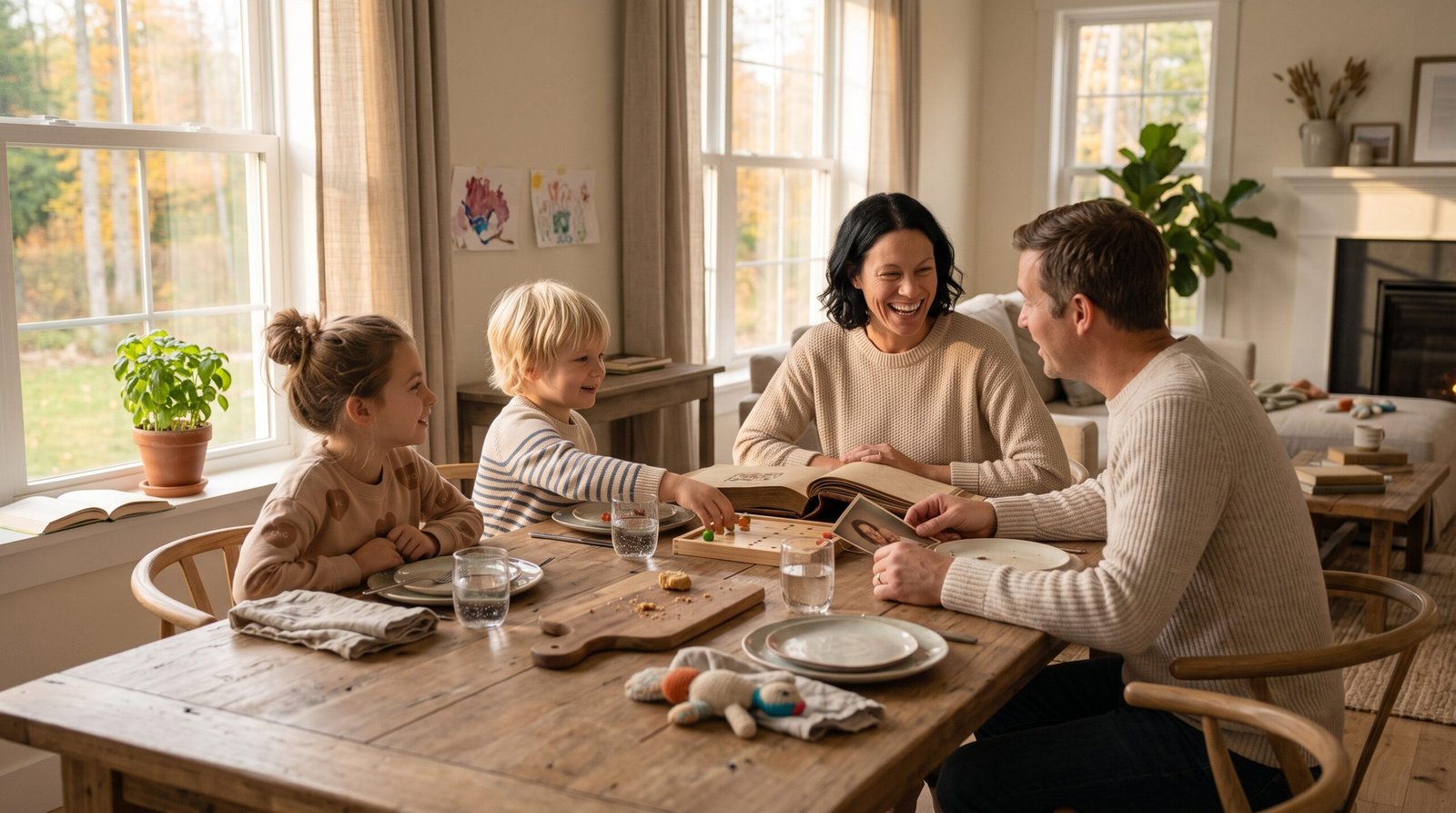
Finding time to connect as a family can feel surprisingly difficult.
Between work, school, homework, meals, chores, appointments, activities, and everything else that fills a normal week, family members can easily spend a lot of time in the same house without actually spending much meaningful time together.
The good news is that family time ideas don’t have to involve expensive outings, elaborate vacations, or hours of planning.
Sometimes, the most meaningful moments happen during ordinary parts of the day.
A family dinner can become a conversation everyone remembers. A short walk can turn into a weekly tradition. Reading together can create a quiet moment of connection before bedtime.
The goal isn’t to create a perfect family schedule.
The best family time ideas are often the simplest ones because they’re easier to fit into real family life.
It’s to create small opportunities to slow down, pay attention to one another, and enjoy being together.
Here are 10 simple family time ideas that can work for different ages, schedules, and family routines.
1. Have a Weekly Family Dinner
A family dinner doesn’t need to be complicated.
It can be homemade pizza, tacos, sandwiches, leftovers, or a meal you’ve prepared after a long day.
What matters is creating an opportunity to sit down together without everyone immediately disappearing to a different room.
If possible, put phones and other distractions aside for part of the meal.
You can make conversation easier by asking simple questions:
- What was the best part of your day?
- Did anything make you laugh today?
- What was something difficult?
- What are you looking forward to?
- If you could choose tomorrow’s dinner, what would you pick?
You don’t need to force everyone to have a deep conversation.
Sometimes ordinary conversation is enough.
And if eating together every night isn’t realistic, start with one or two evenings each week.
The American Academy of Pediatrics notes that family rituals can help create feelings of closeness, and shared activities such as eating together can become meaningful parts of family life.
2. Create a Family Walk Tradition
You don’t need to plan a hiking trip to spend time outdoors together.
A short walk around the neighborhood can become a simple family tradition.
Choose one evening each week, if your schedule allows, and go for a walk together.
You can make the walk more interesting for children by giving them something to look for.
Try:
- Finding five different types of leaves
- Looking for interesting clouds
- Counting dogs you see
- Finding three different colors
- Looking for birds
- Taking turns choosing the direction
- Photographing something interesting
Older children may enjoy longer walks or conversations without a structured activity.
The important thing is that the walk gives everyone a chance to step away from screens and the usual household routine.
And because it doesn’t require much preparation, it’s easier to repeat.
3. Start a Family Reading Tradition
Reading together doesn’t have to be limited to young children.
You can adapt the idea as children grow.
Younger children might enjoy having a parent read a picture book aloud.
School-age children can take turns reading chapters.
Older children might prefer reading their own books while everyone spends the same 20 or 30 minutes together in a comfortable room.
You could even create a family reading night once a week.
Choose a comfortable location, make a simple snack, and let everyone bring a book.
The activity doesn’t need to be completely silent.
You can talk about what you’re reading, recommend books to one another, or share a favorite character.
Shared reading and other responsive interactions can also create opportunities for connection between children and caregivers. Harvard’s Center on the Developing Child describes these back-and-forth interactions as important experiences in children’s development.
4. Have a “No Plans” Family Hour
Sometimes family time becomes stressful because parents feel responsible for organizing everything.
Instead, try doing the opposite.
Choose one hour when nobody has a specific plan.
Put away the phones, turn off unnecessary distractions, and let everyone decide what they want to do.
One child might want to play a board game.
Someone else might want to draw.
Another family member might want to sit outside.
You can even allow people to choose separate activities while staying in the same general space.
The point isn’t that everyone has to participate in exactly the same thing.
It’s simply creating a block of time when the family isn’t rushing toward the next obligation.
This can be especially useful for busy families because it removes the pressure to create a complicated activity.
5. Cook Something Together
Cooking is one of those family activities that can be both practical and enjoyable.
Choose something simple enough that everyone can participate.
Depending on age, children can:
- Wash fruits and vegetables
- Stir ingredients
- Measure ingredients
- Read recipe instructions
- Set the table
- Decorate cookies
- Help prepare pizza toppings
- Choose between two recipes
Older children can gradually take on more responsibility with appropriate supervision.
You can also turn cooking into a small family tradition.
For example:
Friday Pizza Night
Everyone chooses a topping.
Saturday Breakfast
The children help prepare pancakes or another simple breakfast.
Sunday Dessert
The family makes one homemade dessert together.
The activity doesn’t have to produce perfect food.
The process is part of the family time.
And when children participate in everyday tasks, they also have opportunities to practice responsibility and independence.
6. Create a Family Game Night
Game night is a classic family time idea for a reason: it gives everyone something to do together without requiring much preparation.
Pull out a board game, card game, puzzle, or even a simple homemade game.
If you have children of different ages, choose games that allow everyone to participate.
You can also create your own traditions.
For example:
- First Friday of the month = board game night
- Everyone chooses one game
- Winner gets to choose dessert
- One person creates a homemade trivia round
- Parents choose a childhood favorite game
Try not to make winning the entire purpose of the evening.
For younger children especially, the interaction may be more important than the result.
And if a particular game causes too many arguments, simply choose another one.
Family time should create connection, not another source of stress.
7. Look Through Old Family Photos
This is one of the easiest activities to do at home, and it requires almost no preparation.
Open an old photo album or look through pictures on a computer or television.
Choose a few photos and tell the stories behind them.
Children often enjoy hearing about what their parents were like when they were younger.
You can talk about:
- Family vacations
- Old homes
- Childhood pets
- Funny family moments
- Birthdays
- Holidays
- School memories
- Relatives children may not remember
You can also let children ask questions.
This can become especially meaningful as children grow older because family stories help connect different generations.
If you have a large collection of digital photos, consider creating a simple family album together.
Let children choose some of their favorite pictures and explain why they chose them.

8. Start a Small Family Tradition
Family traditions don’t have to involve holidays.
They can be tiny rituals that happen regularly.
For example:
- Pancakes on Saturday mornings
- A Friday night movie
- Sunday afternoon walks
- Birthday breakfast
- A special dessert on the first day of each month
- Reading together before bed
- A family photo on the first day of school
- Hot chocolate on the first cold weekend of fall
The tradition itself doesn’t have to be impressive.
What makes it special is repetition.
Children may come to associate the activity with comfort, familiarity, and belonging.
You can also let children help create the tradition.
Ask:
“What’s something you’d like our family to do regularly?”
You might get surprisingly simple answers.
And sometimes those simple ideas become the traditions everyone remembers.
9. Have a Family Creativity Night
Not every family activity needs to be about winning, learning, or accomplishing something.
Give everyone an opportunity to create.
Set out simple materials such as paper, crayons, markers, cardboard, magazines, or whatever you already have.
Then choose a loose theme.
Try:
Create a dream house.
Invent a new animal.
Design a family flag.
Make a comic strip.
Build something from cardboard.
Draw what your perfect day would look like.
Parents should participate too.
Children often enjoy seeing adults create something imperfect.
The point isn’t producing artwork worthy of a frame.
It’s spending time together while everyone experiments with ideas.
And if your family doesn’t enjoy crafts, creativity can take other forms.
You could write a silly story together, make up a song, build something with blocks, or invent a family game.
10. Take Turns Planning Family Time
One of the best ways to make family time more sustainable is to stop making one person responsible for everything.
Instead, take turns.
Each week, one family member gets to choose a simple family activity.
It could be:
- A movie
- A game
- A walk
- Baking
- A picnic
- A craft
- A restaurant meal
- A visit to the library
- Looking through family photos
Set a reasonable budget if necessary.
The activity doesn’t have to cost anything.
These family time ideas can be adapted to your family’s schedule, budget, and children’s ages.
The important part is giving everyone a chance to contribute.
Younger children can choose between two or three options.
Older children can take more responsibility for planning.
This can make family time feel more like something everyone owns rather than another task assigned by Mom.
Why Small Moments of Connection Matter
It’s easy to think family connection requires large amounts of uninterrupted time.
It doesn’t always work that way.
A parent may not have three free hours every afternoon.
But there may be ten minutes during breakfast, fifteen minutes before bedtime, or a short period after dinner.
Those moments can still matter.
Harvard’s Center on the Developing Child explains that responsive, back-and-forth interactions between children and caring adults help build important foundations for development.
That doesn’t mean every family interaction needs to become a developmental exercise.
Quite the opposite.
It can simply mean paying attention when your child wants to tell you something, responding to a question, laughing together, listening to a story, or joining a game for a few minutes.
Connection often happens in ordinary moments.
Don’t Turn Family Time Into Another Obligation
This is especially important for busy moms.
Family time can become counterproductive if it turns into another item on an already overwhelming checklist.
You don’t need to complete a certain number of family activities every week.
You don’t need to create Pinterest-worthy experiences.
And you don’t need to feel guilty when a busy week gets in the way.
Some weeks might include a planned family game night.
Other weeks might simply include eating dinner together and talking for ten minutes.
Both can be meaningful.
If your family already has a routine, look for natural places to add connection instead of creating an entirely new schedule.
Our guide on How to Create a Simple Family Routine That Actually Works can also help you build family time into the rhythm of your week without making the schedule feel rigid.
How to Make Family Time Work for Different Ages
Families with children of different ages sometimes struggle to find activities everyone enjoys.
The solution isn’t necessarily finding one perfect activity.
Instead, adjust the activity.
For example, a family walk could be a short neighborhood walk for younger children and a longer walk for teenagers.
A game night could include a simple game for younger children and a more strategic game afterward.
A cooking activity could involve decorating for younger children and measuring ingredients for older children.
You can also allow different levels of participation.
A teenager may not want to play the same game as a six-year-old, but they might enjoy choosing the music, preparing snacks, or helping younger siblings.
Family time doesn’t require everyone to enjoy every minute in exactly the same way.
It simply requires some shared space for connection.

A Simple Weekly Family Time Plan
If you want to make these ideas easier to use, try creating a flexible weekly rhythm.
For example:
Monday: 15-minute family conversation
Wednesday: Family game or reading time
Friday: Movie or homemade pizza night
Saturday: Outdoor walk or family activity
Sunday: Look through photos, prepare a meal, or relax together
You don’t have to follow this schedule perfectly.
Think of it as a menu rather than a rulebook.
If Wednesday becomes too busy, move family game night to Thursday.
If everyone is exhausted on Saturday, stay home and watch a movie.
The purpose is to create opportunities, not pressure.
Frequently Asked Questions
How much family time should we have each day?
There isn’t one required amount of family time that works for every household. A few meaningful minutes can be valuable, especially when parents are attentive and engaged. Focus on consistency and connection rather than trying to reach a specific number of hours.
What are simple family time ideas for busy parents?
Try activities that require little preparation, such as eating dinner together, taking a short walk, reading, playing one quick game, looking through family photos, or talking before bedtime.
How can I make family time more meaningful?
Put away distractions when possible, listen to your children, ask questions, participate in activities they enjoy, and give everyone opportunities to contribute ideas.
What if my children don’t want to participate?
Don’t force every activity to become a group event. Give children choices and consider their ages and interests. Sometimes simply being together in the same room can create opportunities for connection.
Does family time have to cost money?
No. Many meaningful family activities are free. Walking, reading, cooking with ingredients you already have, playing games, looking at photos, talking, and creating things together can all become family time.
The Bottom Line
The best family time ideas aren’t necessarily the most elaborate ones.
They are the ones your family can actually enjoy and repeat.
Have dinner together.
Take a walk.
Read a book.
Play a game.
Cook something.
Look through old photographs.
Create a small family tradition.
Or simply sit together and talk.
You don’t need a perfect house, a completely free schedule, or expensive activities to create meaningful family memories.
What children often need most is the experience of being noticed, listened to, and included.
Family connection can happen in ten minutes at the kitchen table or during a long Saturday afternoon.
The important thing is making room for those moments.
Start small.
Choose one of these family time ideas and make it part of your week.
You may find that the simplest traditions become the ones your family looks forward to most.
Post Comment