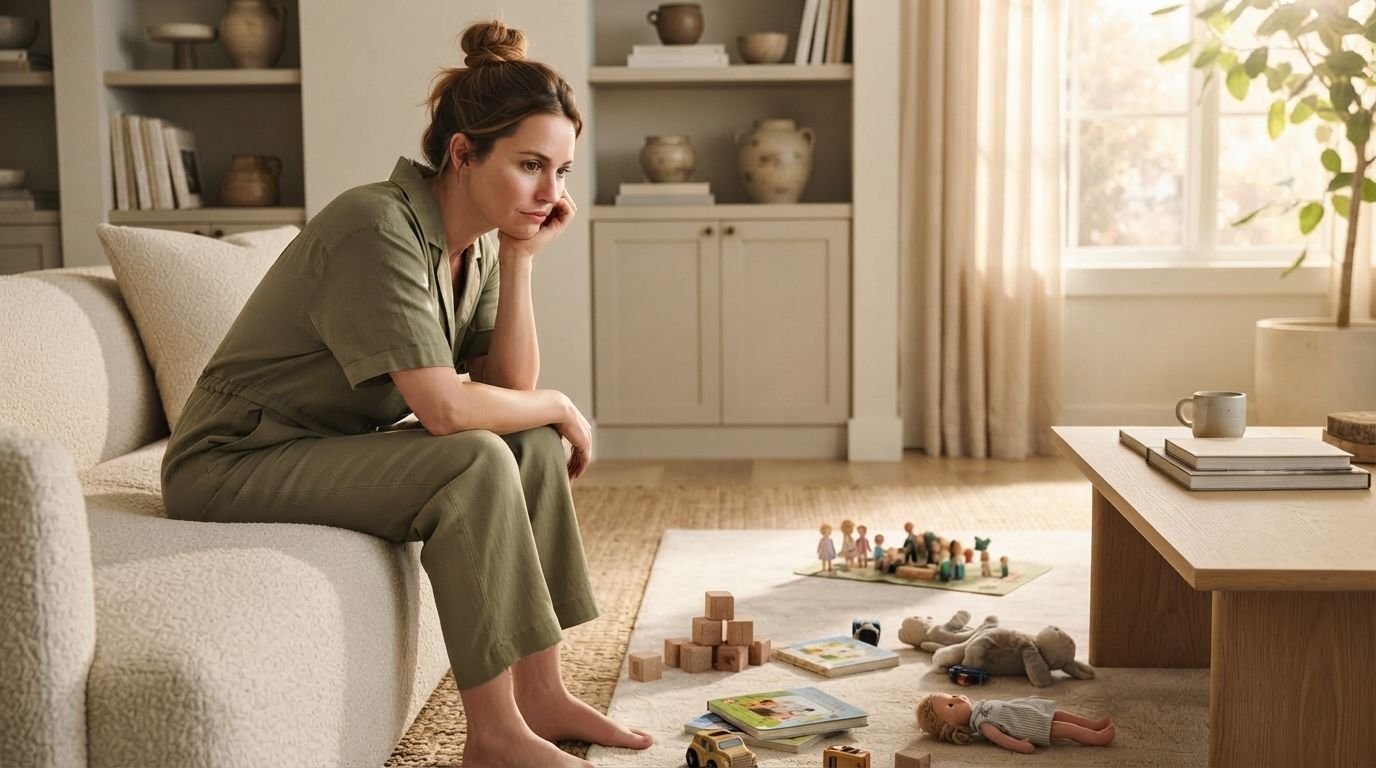
If you’re wondering how to get kids to clean up toys without asking over and over again, you’re definitely not the only mom dealing with this.
You ask nicely.
Then you remind them.
Then you ask again.
Eventually, you’re standing in the middle of a room covered in toys, wondering why you are the one picking everything up.
Cleaning up doesn’t have to become a daily argument, though.
The goal isn’t to make your child perfectly organized or expect them to clean like an adult.
Learning how to get kids to clean up toys is really about creating a routine that children can understand and eventually follow on their own.
Children are still learning how routines work, how to follow instructions, how to transition from one activity to another, and how to take care of their belongings.
With a few simple changes, you can make cleanup easier to understand and much less exhausting for everyone.
Why Kids Don’t Want to Clean Up
From your perspective, cleaning up may seem simple: the toys are on the floor, so they need to go back where they belong.
For a child, it can feel completely different.
Maybe they have been playing for an hour and don’t want the fun to end. Maybe they have used several different toys to create an elaborate game. Or maybe the room is so messy that they genuinely don’t know where to begin.
“Clean your room” can sound like one small instruction to an adult, but it can actually be a very large task for a young child.
The American Academy of Pediatrics recommends age-appropriate chores and explains that children can learn responsibility through everyday tasks such as putting toys away. It also recommends giving children clear, manageable directions.
That means the solution may not be asking more often.
It may be making the task easier to understand.
If you’re trying to get kids to clean up toys, start by making the job feel manageable rather than treating the entire mess as one big task.
Stop Asking Them to Clean Up Everything at Once
One of the simplest changes you can make is to stop treating the entire mess as one giant job.
Instead of saying:
“Clean up all your toys.”
Try:
“Let’s put the blocks away first.”
Once the blocks are finished:
“Now let’s put the cars away.”
Then move to the next group.
This gives your child a clear starting point instead of asking them to figure out the entire cleanup process themselves.
As they get older and become more comfortable with the routine, you can gradually give them more independence.
The long-term goal is not for you to stand there giving instructions forever.
It is to teach your child how to break a big task into smaller ones.
Give One Simple Instruction at a Time
Young children can become overwhelmed when they hear a long list of instructions.
For example:
“Put the toys away, put your books on the shelf, take your clothes upstairs, clean the floor, and then come downstairs for dinner.”
That’s a lot to remember.
Instead, give one direction.
“Put the blocks in the basket.”
Then give the next instruction when that is finished.
This may seem like more work for you at first, but it can actually reduce frustration because your child knows exactly what you expect.
Clear instructions also make it easier for you to notice whether your child needs help or simply needs a little more time.
Make It Easy to Know Where Toys Belong
Sometimes children aren’t refusing to clean up.
They simply don’t know where everything goes.
If a child has to figure out a complicated storage system every time they clean, the task becomes harder than it needs to be.
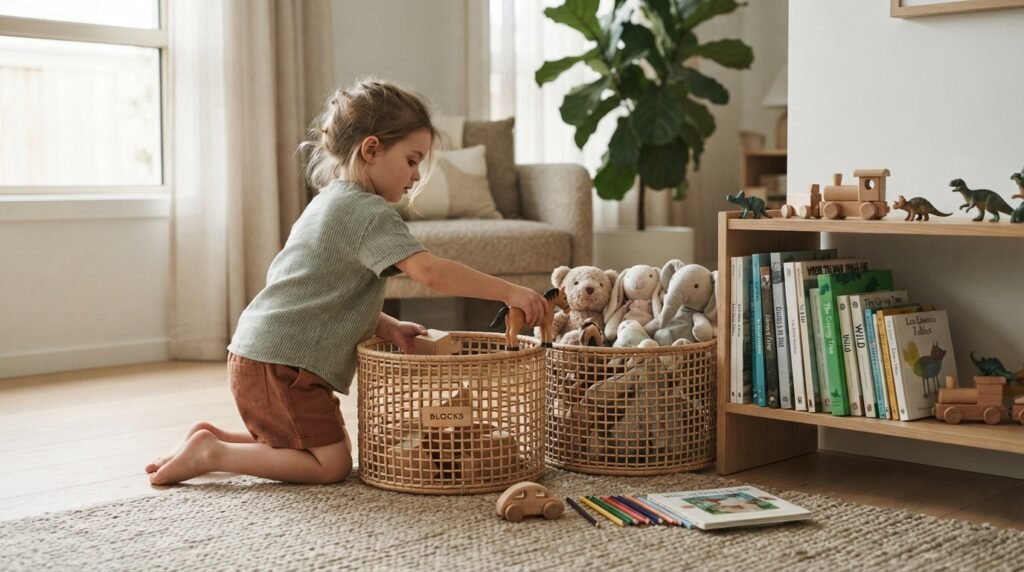
Keep storage simple.
You could have:
- One basket for stuffed animals
- One bin for building toys
- One container for cars
- One shelf for books
- One box for art supplies
- One place for dress-up clothes
You don’t need a perfectly organized playroom.
You need a system your child can actually use.
A simple storage system can make it much easier to get kids to clean up toys without needing constant reminders.
Open baskets and easy-to-reach shelves can be especially helpful for younger children because they don’t have to ask you for help every time they want to put something away.
Reduce the Number of Toys on the Floor
If your child’s room or play area is constantly covered in toys, take a look at how many toys are available at once.
If toy clutter is only one part of a larger mess, you may also find these practical ideas helpful in How to Organize a Messy House.
Children don’t necessarily need every toy to be accessible every day.
Try rotating some of them.
Put a few toys away for a while and bring them back later. You may be surprised by how interested your child becomes when an old toy suddenly feels new again.
Fewer choices can make it easier to get kids to clean up toys because there are fewer things to sort and put away.
Having fewer toys available can also make cleanup much more manageable.
Instead of looking at a floor covered with dozens of objects, your child sees a smaller number of things that need to be put away.
And if cleanup takes five minutes instead of thirty, you’re much less likely to dread doing it.
Give a Warning Before Cleanup Time
One reason cleanup can lead to an argument is that it often comes at the worst possible moment.
Your child is deeply involved in playing, and suddenly you say:
“Clean up. It’s time for dinner.”
To your child, it may feel like the fun has ended without warning.
Try giving a transition warning instead.
“Five more minutes, then we’re going to clean up.”
Then, when the time is almost over:
“Finish what you’re doing. Cleanup is next.”
This doesn’t guarantee that your child will happily jump up and start cleaning.
But it gives them time to mentally switch from playtime to the next activity.
That small warning can make transitions easier.
Make Cleanup a Normal Part of the Day
Instead of waiting until the room becomes completely overwhelming, create small cleanup moments throughout the day.
For example:
After morning play: Put the toys away before lunch.
Before leaving home: Return the toys to their places.
Before dinner: Do a quick family cleanup.
Before bedtime: Make sure the floor is clear.
The American Academy of Pediatrics emphasizes the value of predictable family routines and age-appropriate responsibilities.
When cleanup happens at approximately the same point in the daily routine, it becomes less of a surprise.
Eventually, “It’s cleanup time” can become a familiar cue instead of the beginning of an argument.
This kind of predictable routine can make it easier to get kids to clean up toys because cleanup becomes something they expect rather than something that suddenly interrupts their day.
Turn Cleanup Into a Team Effort
You don’t always have to send your child into the messy room alone.
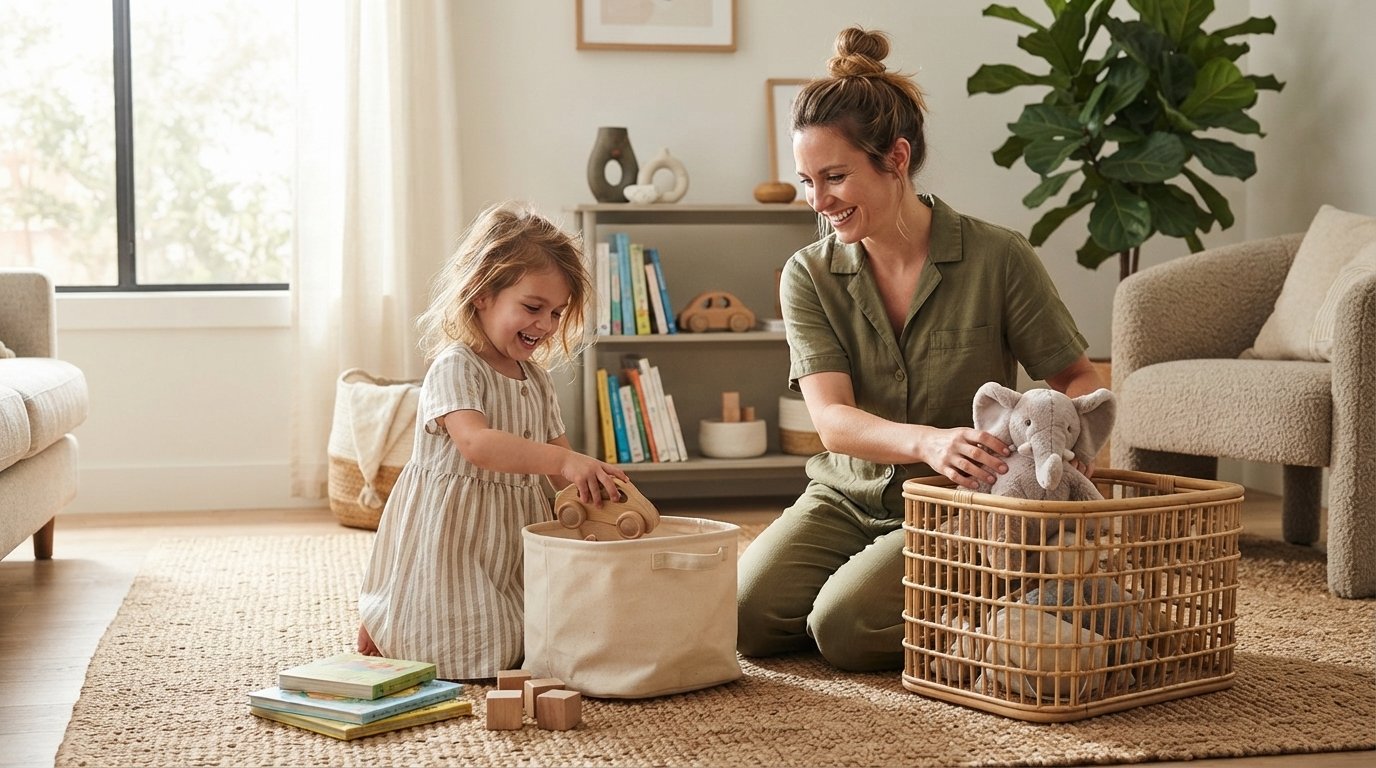
Especially when you’re introducing a new routine, do it together.
You might say:
“I’ll pick up the books, and you pick up the stuffed animals.”
Or:
“Let’s see if we can get all these blocks into the basket.”
This isn’t about doing the work for your child.
It is about showing them what participation looks like.
When you first start trying to get kids to clean up toys, your involvement can make the transition feel much less overwhelming.
Once your child understands the routine, you can step back and let them handle more of it independently.
The AAP notes that chores can help children develop responsibility and learn to contribute to the family.
Let Your Child Choose What to Clean First
A small amount of choice can make a surprisingly big difference.
Instead of:
“Start cleaning right now.”
Try:
“Do you want to put away the cars or the blocks first?”
Or:
“Would you rather clean up the books or the stuffed animals?”
You are still setting the expectation that cleanup needs to happen.
Your child simply gets to choose how to begin.
This can be especially helpful for children who resist being told exactly what to do every step of the way.
The AAP recommends giving children appropriate choices while maintaining clear limits.
Don’t Expect the Room to Look Perfect
This is a big one.
Your child’s idea of “clean” may not look exactly like yours.
A preschooler may put all the stuffed animals in the basket but leave them sticking out.
A young child may put the books back on the shelf without arranging them perfectly.
A school-age child may get most of the toys away but miss a few pieces underneath the furniture.
That doesn’t mean the system failed.
Your child is learning.
If you immediately redo everything because it isn’t exactly how you would do it, your child may start to feel that their effort isn’t good enough.
The AAP recommends recognizing children’s effort as they learn household responsibilities rather than expecting perfection.
The purpose of cleanup is not to create a picture-perfect room.
When you focus on teaching the habit, you are more likely to get kids to clean up toys consistently over time instead of creating another source of frustration.
It is to teach a useful habit.
Notice When Your Child Helps
If your child normally needs ten reminders and suddenly puts away a basket of toys without being asked, notice it.
You don’t need a huge reward.
A simple comment can be enough:
“You remembered to put those away.”
Or:
“Thank you for helping with the cleanup.”
Or:
“You put all the cars away by yourself.”
Specific praise helps your child understand exactly what behavior you appreciated.
It also changes the atmosphere around cleanup.
Instead of only receiving attention when they refuse, argue, or leave a mess behind, your child begins receiving positive attention when they cooperate.
What to Do When They Still Refuse
Even with a good routine, there will be days when your child simply doesn’t want to clean up.
You don’t have to turn every refusal into a huge battle.
Stay calm.
Repeat the expectation.
Keep your words simple.
You might say:
“It’s time to put the toys away. I’ll help you get started.”
If you use a consequence, make sure it is reasonable and something you can consistently enforce.
For example, you might decide that toys left out at the end of the day are put away until the next day.
The American Academy of Pediatrics recommends clear, consistent limits and calmly explained consequences as part of positive discipline.
The important thing is to avoid turning a five-minute cleanup into a thirty-minute argument.
You’re trying to teach a responsibility, not win a confrontation.
Don’t Make Cleanup the Punishment for Everything
There is a difference between teaching a child to take care of their belongings and using cleanup as a punishment whenever they misbehave.
Whenever possible, treat putting toys away as a normal part of play.
Play happens.
Cleanup happens.
Then everyone moves on.
That simple rhythm teaches children that taking care of their things is part of everyday life.
It isn’t something they do only because they are in trouble.
Create a Five-Minute Cleanup Habit
You don’t need an elaborate reward chart or complicated system to get started.
Try a five-minute reset.
Set a timer if your child enjoys that kind of challenge, and work together until the five minutes are over.
During those five minutes, focus only on the biggest areas of clutter.
Toys into baskets.
Books onto shelves.
Stuffed animals into their container.
Then stop.
You can gradually adjust the routine as your child gets older.
The goal is consistency, not perfection.
A Simple Cleanup Routine to Try Tonight
If you want to start changing your child’s cleanup habits today, keep it very simple.
1. Give a warning.
“Five more minutes, then we’ll clean up.”
2. Start with one category.
“Let’s put the blocks away.”
3. Work together if necessary.
You can help without taking over.
4. Give your child a choice.
“Cars or books next?”
5. Finish with a quick check.
“Let’s look around and see if anything is still on the floor.”
6. Notice the effort.
“Thank you for helping.”
You don’t have to do all of this perfectly.
What matters most is creating a predictable pattern that your child can learn.
With practice, these small steps can help you get kids to clean up toys with fewer reminders.
When You Stop Fighting About the Toys
Getting kids to clean up their toys isn’t really about having a spotless playroom.
It is about teaching a child that they are part of the household and that everyone helps take care of the space they share.
There will still be messy days.
There will still be toys under the couch.
There will still be evenings when your child would rather keep playing than put anything away.
That’s normal.
But when toys have obvious homes, cleanup happens at predictable times, instructions are simple, and you stop expecting perfection, the process can become much easier.
You may eventually notice something that feels small but is actually a big change.
You say:
“It’s time to clean up.”
And instead of starting another daily battle, your child knows what comes next.
That is the habit you’re trying to build.
Not a perfectly clean room.
Not a perfectly obedient child.
Just a child who is gradually learning how to take care of their things—and a mom who doesn’t have to pick up every toy herself.
Post Comment