Finding something fun to do with children at home doesn’t always require expensive toys, elaborate crafts, or hours of preparation.
Sometimes, the best activities begin with whatever you already have around the house.
When you need fun activities to do with kids at home, starting with simple things you already have can make family time much easier.
When you’re looking for fun activities to do with kids at home, the goal doesn’t have to be keeping children entertained every minute of the day. It can simply be creating opportunities to play, explore, create, laugh, and spend meaningful time together.
At-home activities can be especially useful on rainy afternoons, weekends, school breaks, or those days when everyone needs a break from the usual routine.
And they don’t have to be complicated.
A blanket can become a fort. A cardboard box can become a pretend house. A kitchen table can turn into an art studio, game table, or science experiment station.
The best part is that many activities can be adapted for different ages.
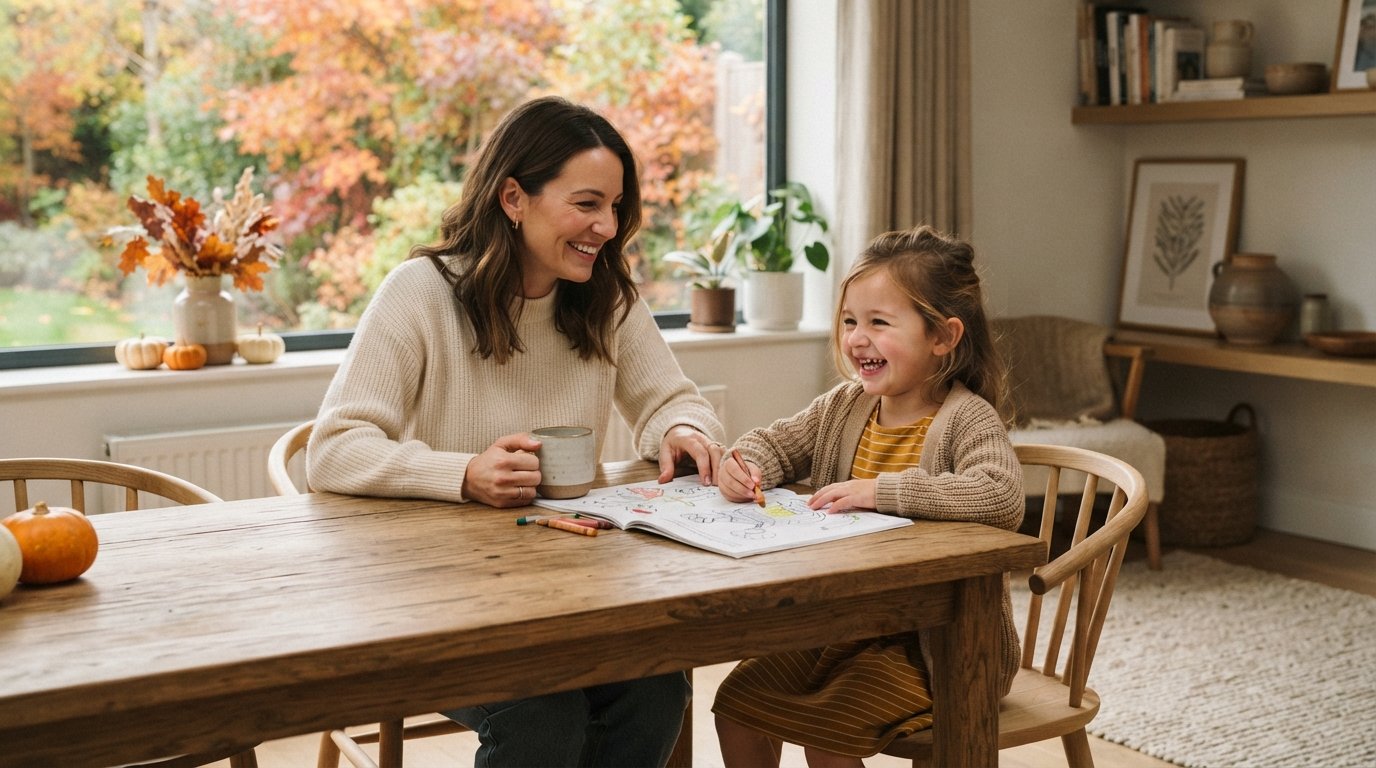
1. Have a Family Art Afternoon
You don’t need to be an artist to enjoy creating something together.
Set up a simple art station using paper, crayons, colored pencils, washable markers, paint, or whatever supplies you already have.
Instead of giving children a specific project they have to copy, give them a theme.
Try:
- Draw your dream house.
- Create an imaginary animal.
- Design a new planet.
- Draw your perfect weekend.
- Make a family picture.
- Create a picture using only three colors.
You can participate too.
Sometimes children enjoy an activity more when parents sit down and create alongside them rather than simply watching.
For younger children, keep the materials simple and washable.
Older children may enjoy more detailed drawing, painting, collage, or mixed-media projects.
The objective isn’t creating something perfect.
It’s giving everyone an opportunity to be creative.
2. Build an Indoor Fort
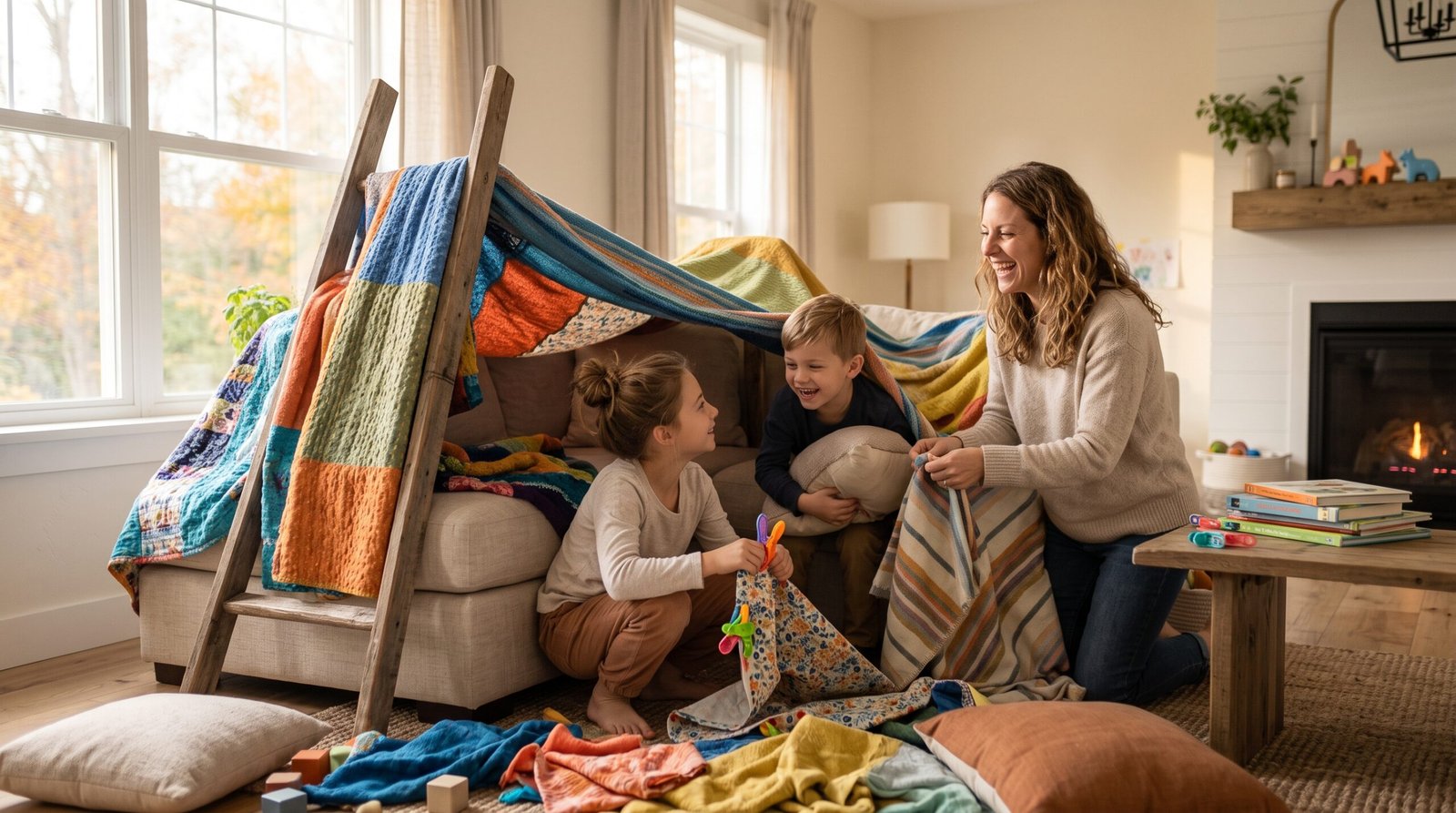
Few things require less preparation than a good old-fashioned blanket fort.
Use blankets, pillows, couch cushions, chairs, and sheets to create a small indoor hideaway.
Once the fort is finished, give it another purpose.
You could:
- Read books inside.
- Tell stories.
- Have a snack.
- Play with stuffed animals.
- Watch a family-friendly movie.
- Pretend the fort is a campsite.
- Create a secret reading club.
Let the children help design it.
They can decide where the entrance goes, what the fort is called, and what happens inside.
You may be surprised by how long children can stay engaged when they have a space they helped create.
3. Create a Family Baking Project
The kitchen can become one of the easiest places to find a family activity.
Choose a simple recipe and let children participate in age-appropriate ways.
Younger children might help stir ingredients, add pre-measured ingredients, or decorate finished treats.
Older children can read the recipe, measure ingredients, organize the workspace, and eventually prepare more of the recipe themselves with appropriate supervision.
You could make:
- Cookies
- Muffins
- Pancakes
- Homemade pizza
- Banana bread
- Cupcakes
Don’t worry if the kitchen gets a little messy.
The experience itself is part of the activity.
You can also turn baking into a learning opportunity by talking about measurements, ingredients, temperatures, and how different ingredients change during cooking.
4. Have a Family Game Tournament
Pull out the board games, cards, puzzles, or other games you already own.
Instead of playing just one game, create a small family tournament.
Everyone can earn points for each round, and the winner at the end gets a simple prize such as choosing the next movie or picking dessert.
You can also create your own games.
Try a guessing game, trivia challenge, charades, or a simple scavenger hunt.
The goal isn’t necessarily competition.
For younger children, cooperative games can be especially enjoyable because everyone works toward the same goal.
Older children may enjoy more strategic games that require planning and problem-solving.
If you don’t have board games at home, paper and pencils can be enough to create several simple games.
5. Organize an Indoor Scavenger Hunt
A scavenger hunt can turn an ordinary afternoon into an adventure.
Create a list of things children need to find around the house.
For example:
- Something blue
- Something soft
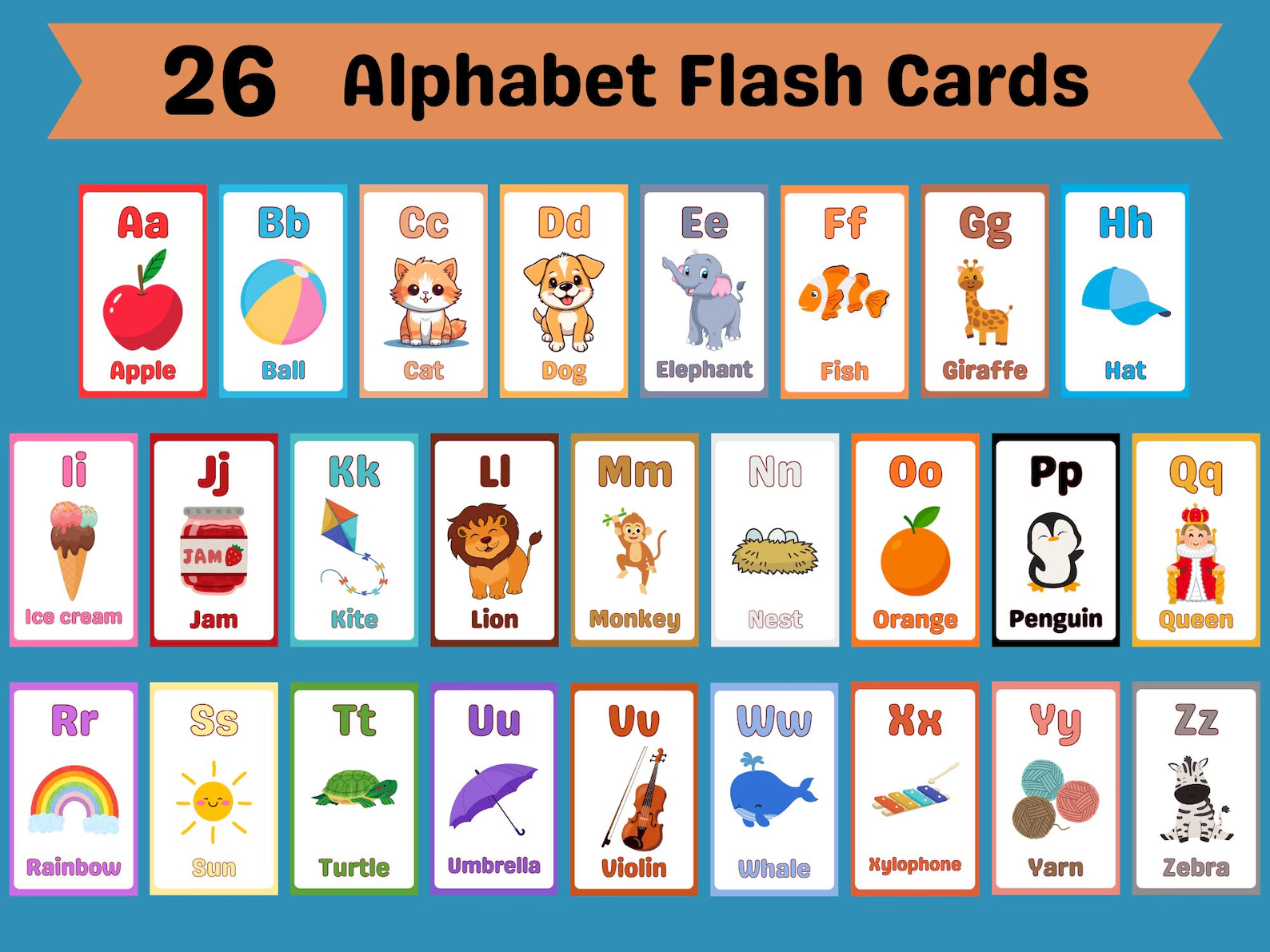
- Something that starts with the letter B
- A favorite book
- Something smaller than your hand
- Something that makes noise
- Something that reminds you of summer
For younger children, you can use pictures instead of written clues.
Older children can create clues for one another.
You can also create a treasure hunt with clues leading from one location to another.
It doesn’t need to involve prizes.
Sometimes solving the clues is enough to make the activity exciting.
6. Make a DIY Movie Night
Movie night doesn’t have to mean simply turning on the television.
Let the children help create the experience.
Make simple tickets using paper.
Choose a movie together.
Prepare popcorn or another favorite snack.
Arrange blankets and pillows.
You could even create a small “movie theater” sign for the living room.
If you have older children, let them take turns choosing the movie on different family nights.
You can also talk about the movie afterward.
Ask:
- What was your favorite part?
- Which character did you like most?
- What would you have done differently?
- What do you think happened after the ending?
That turns screen time into a shared family experience rather than simply passive entertainment.
7. Start a Family Reading Hour
Reading together is another simple activity that can work for a wide range of ages.
Younger children may enjoy picture books and stories read aloud.
Older children can read independently while everyone stays in the same room.
You could make reading time more special by creating a comfortable reading corner with blankets and pillows.
Choose a theme for the afternoon.
For example:
Adventure afternoon: Read adventure stories.
Animal afternoon: Read books about animals.
Travel afternoon: Read about a place your family would like to visit.
You can also take turns reading aloud.
The American Academy of Pediatrics encourages shared reading because it provides opportunities for connection and supports children’s development.
Reading doesn’t have to feel like homework.
It can simply be a quiet way to spend time together.
8. Have a Living Room Dance Party
Sometimes children don’t need another structured project.
They just need to move.
Choose a playlist that works for the family and have a short dance party in the living room.
You can make it even more fun by creating challenges:
- Freeze when the music stops.
- Let each person choose one song.
- Create a silly dance.
- Have a dance-off.
- Copy another person’s movements.
- Make up a family dance.
This can be especially useful when children have been sitting for a long time.
You don’t need a large space.
Move furniture safely out of the way, keep the volume reasonable, and let everyone have fun.
Adults can participate too.
In fact, children often love seeing their parents being silly.
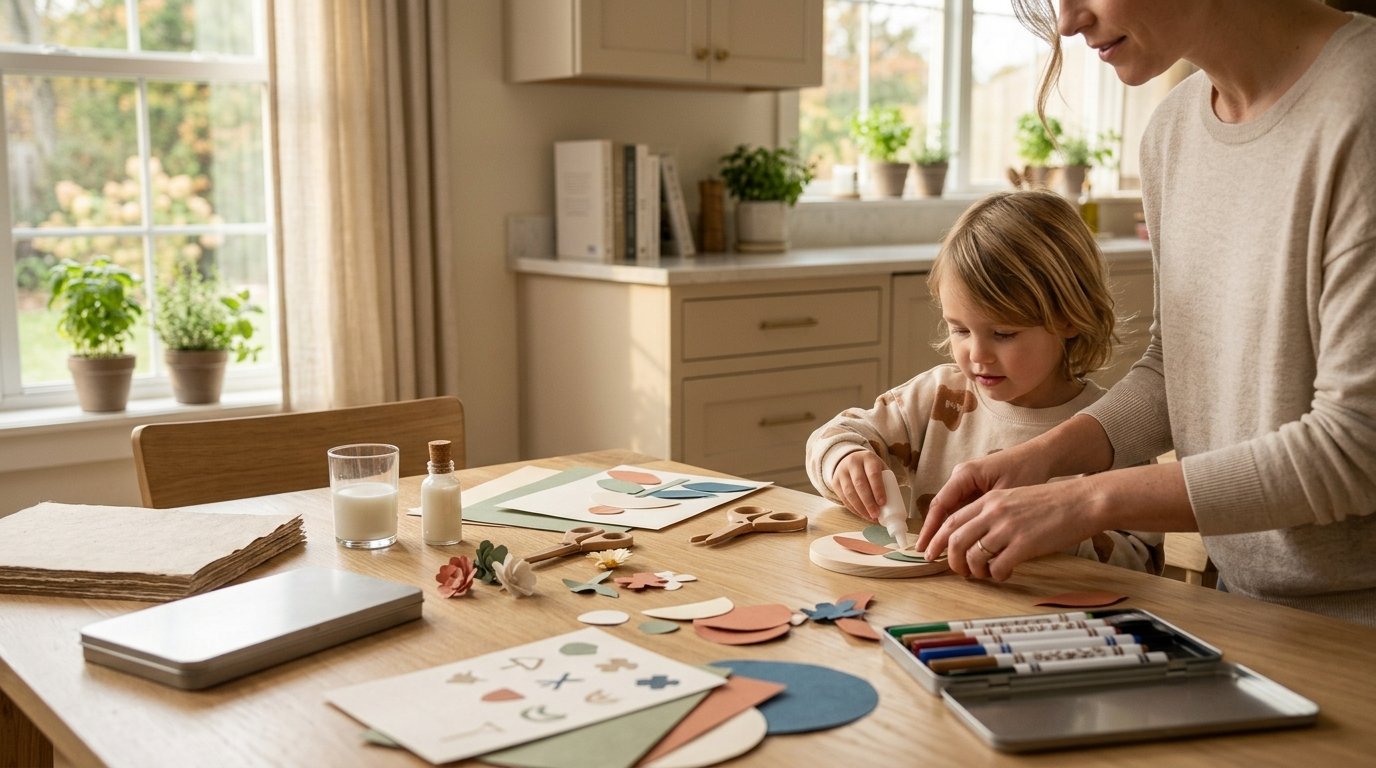
9. Create a Simple Family Craft
You don’t need to buy a special craft kit.
Look around the house for materials that can be reused.
Cardboard boxes, paper bags, toilet paper rolls, old magazines, paper scraps, and leftover wrapping paper can become creative materials.
Try making:
- Paper flowers
- Homemade bookmarks
- Cardboard houses
- Paper puppets
- Greeting cards
- Decorative picture frames
- Homemade paper crowns
You can also create something the family can actually use.
For example, make bookmarks for your reading corner or decorate small storage boxes for children’s belongings.
This connects creativity with everyday family life.
And if the project doesn’t turn out exactly as planned, that’s okay.
Sometimes the unexpected result is the most fun part.
10. Have a “Yes, Let’s Play” Afternoon
This may be one of the simplest ideas on the list.
Choose a period of time when the children get to suggest what the family does.
You might set a limit such as one hour.
During that time, everyone takes turns choosing an activity.
One child might want to build with blocks.
Another might want to play pretend.
Someone else might want to draw.
The activity doesn’t have to be impressive.
The point is giving children an opportunity to make choices and giving parents a chance to participate without trying to direct every moment.
You can even let the children decide the order.
This kind of unstructured family time can sometimes lead to more creative play than a carefully planned activity.
How to Make Fun Activities to Do With Kids at Home Easier
One reason parents sometimes avoid activities at home is the preparation.
You may imagine needing special supplies, a perfectly clean room, or an entire afternoon.
You don’t.
Keep a small box or basket with basic activity supplies.
You could include:
- Paper
- Crayons
- Colored pencils
- Washable markers
- Glue
- Child-safe scissors
- Stickers
- Cardboard
- Craft paper
Having these items together makes spontaneous activities much easier.
You can also save cardboard boxes, clean containers, paper bags, and other reusable materials.
You never know when a simple box will become a spaceship.
Choose Activities Based on Your Child’s Age
Not every activity needs to work for every child.
Younger children may need simpler instructions and more hands-on participation.
School-age children may enjoy challenges, crafts, games, and cooking projects.
Older children may prefer activities that give them more independence.
The same idea can often be modified.
For example, a scavenger hunt for a young child could involve pictures.
For an older child, you could add riddles.
A family baking activity could involve simple decorating for younger children and recipe reading or measuring for older children.
The goal is to make the activity appropriate rather than expecting every child to participate in exactly the same way.
You Don’t Have to Entertain Your Children All Day
This is worth remembering.
Finding fun activities to do with kids at home doesn’t mean you need to fill every hour with entertainment.
Children also benefit from independent play, quiet time, reading, imagination, and simply having moments when there is nothing planned.
You don’t have to become your child’s full-time activity director.
Instead, think of these ideas as opportunities to connect.
One afternoon might involve a craft.
Another might involve baking.
Another might simply involve sitting together and reading.
That’s enough.
Turn Ordinary Moments Into Family Activities
Some of the best family memories don’t come from elaborate plans.
They can come from ordinary moments.
Make breakfast together.
Take turns choosing music.
Fold laundry while talking.
Look through old photographs.
Tell funny stories from when the children were younger.
Create a family joke.
Make homemade pizza on Friday night.
Have a picnic on the living-room floor.
These activities cost little or nothing, but they can create meaningful moments of connection.
A more organized home can also make everyday family activities easier to manage. If you’re looking for practical ways to make your home work better for your family, you may also enjoy our guide on How to Organize Your Home as a Busy Mom.
And because they are simple, they’re easier to repeat.
A Simple Weekly Family Activity Plan
If your family enjoys having something to look forward to, create a simple weekly rhythm.
For example:
Monday: Family reading time
Wednesday: Quick game night
Friday: Movie night
Saturday: Baking or craft project
Sunday: Family walk or relaxed activity
You don’t have to follow this exact schedule.
The idea is simply to make family time easier to remember.
And if a week becomes too busy, skip it.
There is no need to feel guilty.
Family connection isn’t measured by how many activities you complete.
Frequently Asked Questions
What are fun activities to do with kids at home?
Some simple ideas include baking together, building a blanket fort, creating art, playing board games, having a scavenger hunt, reading, dancing, crafting, and having a family movie night.
What can I do with my kids when we’re bored at home?
Try changing the environment rather than buying something new. Build a fort, create a scavenger hunt, make homemade pizza, organize a game tournament, or let your children choose an activity for the family.
How can I entertain kids without spending money?
Many activities require little or no money. Use materials you already have for crafts, play pretend, create indoor games, read books, bake with existing ingredients, or turn ordinary household items into imaginative play materials.
What are good indoor activities for families?
Indoor activities can include board games, reading, crafts, baking, movie nights, scavenger hunts, dance parties, puzzles, and building forts.
How do I keep activities simple as a busy mom?
Choose activities that require minimal preparation and use supplies you already have. You don’t need to plan elaborate projects. A short game, shared meal preparation, reading session, or creative activity can be enough.
Do children need structured activities all day?
No. Children also need opportunities for independent play, rest, imagination, and unstructured time. Family activities are best viewed as opportunities for connection rather than a requirement to keep children constantly entertained.
The best fun activities to do with kids at home are the ones that fit naturally into your family’s everyday life.
The Bottom Line
Finding fun activities to do with kids at home doesn’t have to mean filling your house with expensive toys or planning complicated projects.
Some of the best activities are remarkably simple.
Build a blanket fort.
Bake something together.
Play a game.
Read a book.
Create a scavenger hunt.
Dance in the living room.
Make something from cardboard.
Or simply sit together and talk.
The important part isn’t how impressive the activity looks.
It’s the opportunity to slow down and spend time together.
Your children probably won’t remember whether the craft turned out perfectly or whether your living room looked spotless.
They may remember laughing together, building something with you, choosing a movie, eating homemade cookies, or having a silly dance party in the middle of an ordinary afternoon.
You don’t need to create perfect family days.
You just need moments of connection.
And sometimes, the simplest activity is the one that becomes a favorite family memory.
Post Comment