Creating a family routine sounds easy until you actually have to live with one.
There are mornings when everyone is rushing, afternoons filled with homework and activities, and evenings when everyone is tired and the house somehow becomes even more chaotic.
How to create a simple family routine that actually works is less about creating a perfect schedule and more about giving your family a few predictable habits that make everyday life easier.
A good routine can help children know what to expect, help parents reduce repeated decisions, and make busy parts of the day feel more manageable.
But your family routine doesn’t need to look like someone else’s.
Some families have early mornings and structured evenings. Others have changing schedules, younger children, teenagers, work commitments, or activities that make every day slightly different.
The goal isn’t to control every minute.
It’s to create enough structure that your family knows what usually happens next.
Understanding how to create a simple family routine can make this process easier because you can focus on the parts of the day that matter most.
Here are practical ways to build a simple family routine that can actually work in real life.
1. Start With the Parts of the Day That Feel Most Chaotic
You don’t need to organize the entire day immediately.
Start with the part of your family’s day that creates the most stress.
For some families, that’s the morning.
For others, it’s the period between school and dinner.
For many parents, bedtime is the hardest part.
Instead of trying to create a detailed schedule from waking up until bedtime, choose one difficult period and make it more predictable.
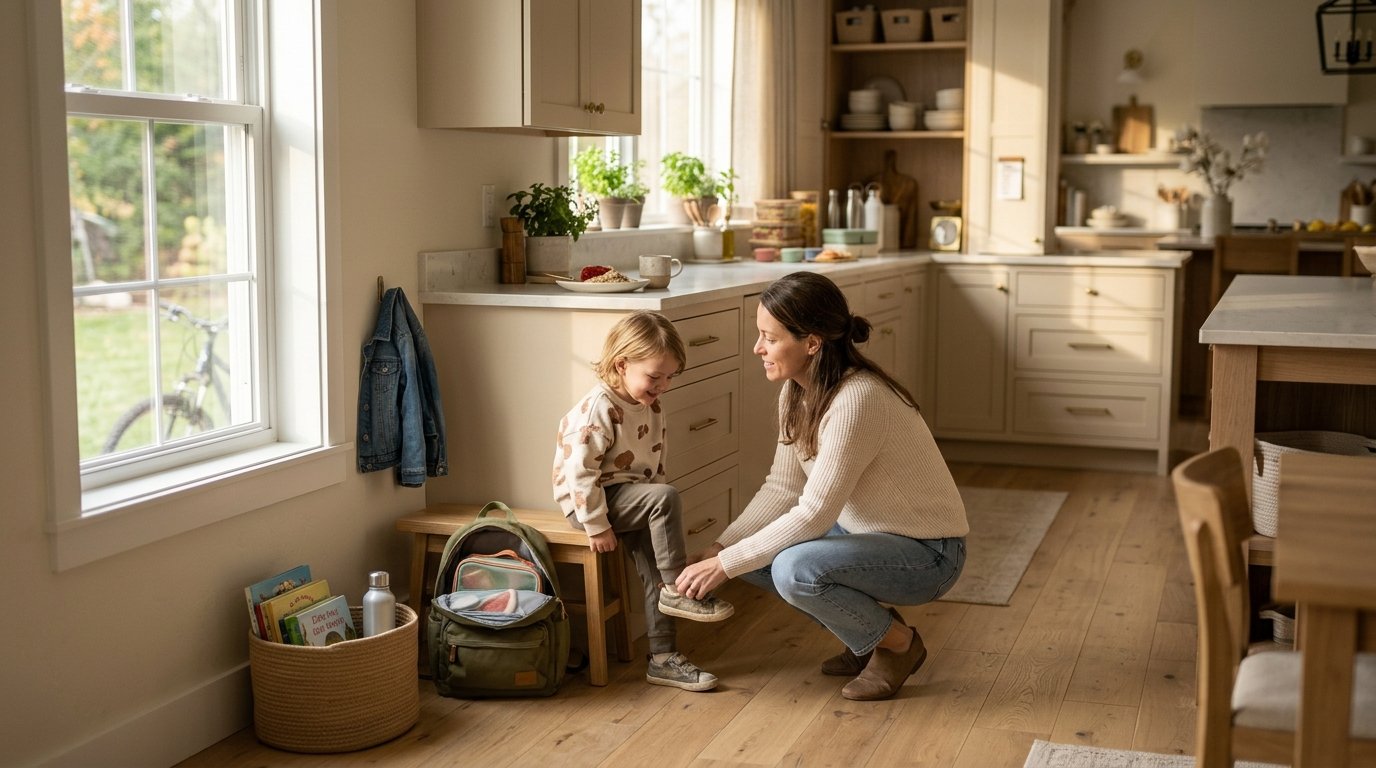
For example, a morning routine might include:
- Getting dressed
- Eating breakfast
- Brushing teeth
- Packing bags
- Putting on shoes
- Leaving the house
You don’t necessarily need exact times for every step.
Simply having the same general sequence can make mornings easier because everyone knows what comes next.
Once that routine feels natural, you can gradually improve another part of the day.
Learning how to create a simple family routine starts with identifying the moments of the day that need the most structure.
2. Keep the Routine Simple Enough to Remember
A family routine becomes difficult when it contains too many steps.
If your children need to remember fifteen different things before leaving the house, you’re probably going to spend much of the morning reminding them.
Instead, focus on the essentials.
A simple routine might be:
Wake up → get dressed → eat → brush teeth → grab belongings → leave.
That’s enough.
The same principle works in the evening.
Dinner → clean up → prepare for tomorrow → relaxing activity → bedtime routine.
Simple routines are easier for children to understand and easier for parents to maintain.
If your routine requires a complicated chart, multiple timers, and constant supervision, it may be time to simplify it.
The best routine is one your family can actually follow.
3. Create a Predictable Morning Routine
Mornings can set the tone for the entire day.
When everyone is rushing, small problems can quickly become bigger ones.
A predictable morning routine can remove some of those unnecessary decisions.
Try preparing a few things the night before.
Backpacks can be placed near the door.
Clothing can be chosen ahead of time.
Lunch items can be prepared when practical.
Shoes and coats can have a designated location.
Breakfast can remain simple on busy mornings.
The objective isn’t to eliminate every possible problem.
It’s to reduce the number of decisions that have to happen when everyone is tired and trying to get out the door.
When you know how to create a simple family routine, small habits like preparing backpacks and clothes the night before can make busy mornings feel much easier.
You can also create a simple visual checklist for younger children.
Pictures or short words can show the sequence:
Get dressed → Eat breakfast → Brush teeth → Shoes → Backpack.
Over time, children may begin following the sequence without needing as many reminders.
4. Build an After-School Routine
The period immediately after school can be surprisingly chaotic.
Children may be hungry, tired, excited, or overwhelmed after a long day.
Instead of expecting everyone to immediately transition into homework or chores, create a short predictable sequence.
For example:
Come home → put belongings away → have a snack → take a short break → homework or activities.
The exact order can be adjusted to your family.
Some children need quiet time first.
Others need food immediately.
Some families have sports or extracurricular activities that change the afternoon schedule.
That’s okay.
A routine doesn’t have to mean doing everything at exactly the same time.
It can simply mean doing familiar activities in a familiar order.
This distinction can make routines much easier to maintain.
5. Give Everyone a Few Responsibilities
A family routine works better when one person isn’t responsible for everything.
Children can participate in age-appropriate household responsibilities.
Younger children might put toys away, place dirty clothes in a hamper, or help set the table.
Older children may be able to manage their backpacks, organize school materials, help with dishes, or take responsibility for parts of their bedtime routine.
The goal isn’t to give children a long list of chores.
It’s to help them understand that maintaining a home is something the family does together.
You can also connect responsibilities to existing routines.
For example:
After dinner → everyone clears their place.
Before bedtime → belongings return to their usual locations.
Before leaving → everyone checks for shoes, bags, and anything else they need.
When responsibilities are attached to an existing routine, they can become easier to remember.
6. Create a Simple Evening Reset
You don’t need to clean your entire house every night.
Instead, create a short reset that prepares the family for tomorrow.
It might take ten or fifteen minutes.
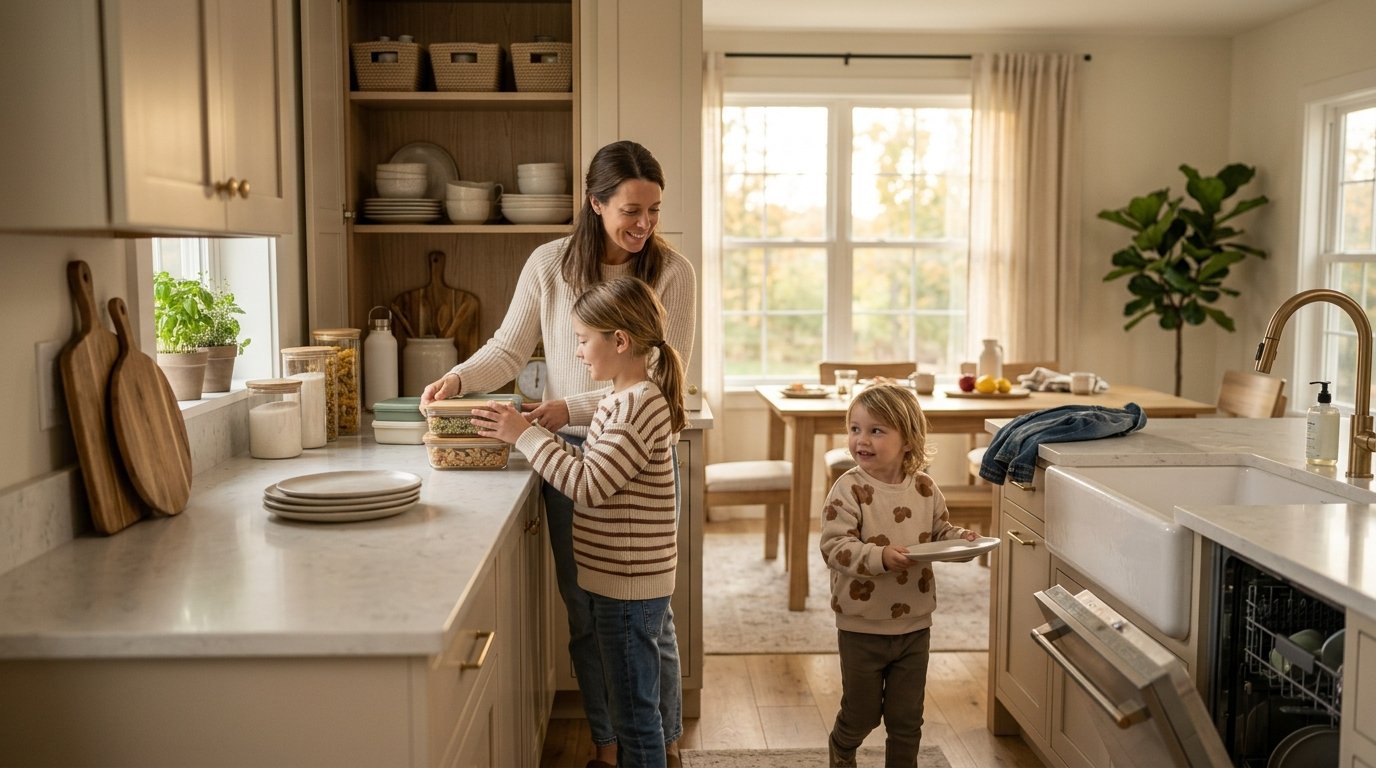
During that time, everyone can return belongings to their usual places, clear the main living area, prepare school bags, and help with the kitchen.
You can make the routine even easier by choosing only three priorities.
For example:
- Kitchen reset
- Belongings put away
- Tomorrow’s essentials prepared
That’s it.
A short routine that happens consistently can be more useful than an ambitious cleaning plan that everyone avoids.
And there will be nights when it doesn’t happen.
That’s normal.
Simply start again the next day.
7. Use Routines Instead of Constant Reminders
One of the biggest benefits of a family routine is reducing the number of times you have to repeat the same instructions.
If you constantly say:
“Put your shoes away.”
“Brush your teeth.”
“Pack your bag.”
“Get your pajamas.”
“Put your toys away.”
you may eventually feel like you’re running the household through verbal instructions alone.
A routine can shift some of that responsibility to the system itself.
Instead of saying what needs to happen every time, establish a predictable sequence.
For younger children, a simple checklist can help.
For older children, you may simply need a consistent expectation.
This doesn’t mean children will suddenly become completely independent.
They won’t.
But predictable routines can gradually make everyday tasks more familiar.
8. Don’t Schedule Every Minute
One common mistake when creating a family routine is making it too rigid.
A family isn’t a machine.
Unexpected things happen.
Someone gets sick.
Traffic takes longer.
Homework takes extra time.
Dinner isn’t ready when planned.
A child needs extra attention.
Your schedule changes.
If every minute is planned, one unexpected event can make the entire routine feel like a failure.
Instead, create flexible blocks.
For example:
Morning: Get ready and leave.
Afternoon: Snack, break, homework, activities.
Evening: Dinner, reset, family time, bedtime routine.
This provides structure without making your family feel like they’re following a military schedule.
A routine should give your family breathing room.
9. Keep Bedtime Predictable
Children often benefit from knowing what happens as bedtime approaches.
A consistent sequence can make the transition from an active evening to sleep easier.
Your routine might include:
- Putting away belongings
- Taking a bath or shower
- Putting on pajamas
- Brushing teeth
- Reading
- Quiet conversation
- Going to bed
You don’t have to use every step.
Choose what makes sense for your family.
For younger children, repeating the same sequence can provide a sense of predictability.
Consistent bedtime routines can also help children transition more smoothly toward sleep. The American Academy of Pediatrics provides guidance for parents on healthy sleep habits and bedtime routines.
For older children and teenagers, bedtime routines may need to be more flexible while still maintaining reasonable expectations around sleep and screen use.
The important thing is consistency without turning bedtime into another battle.
10. Make Your Routine Visible
If everyone needs to remember the routine, don’t rely entirely on memory.
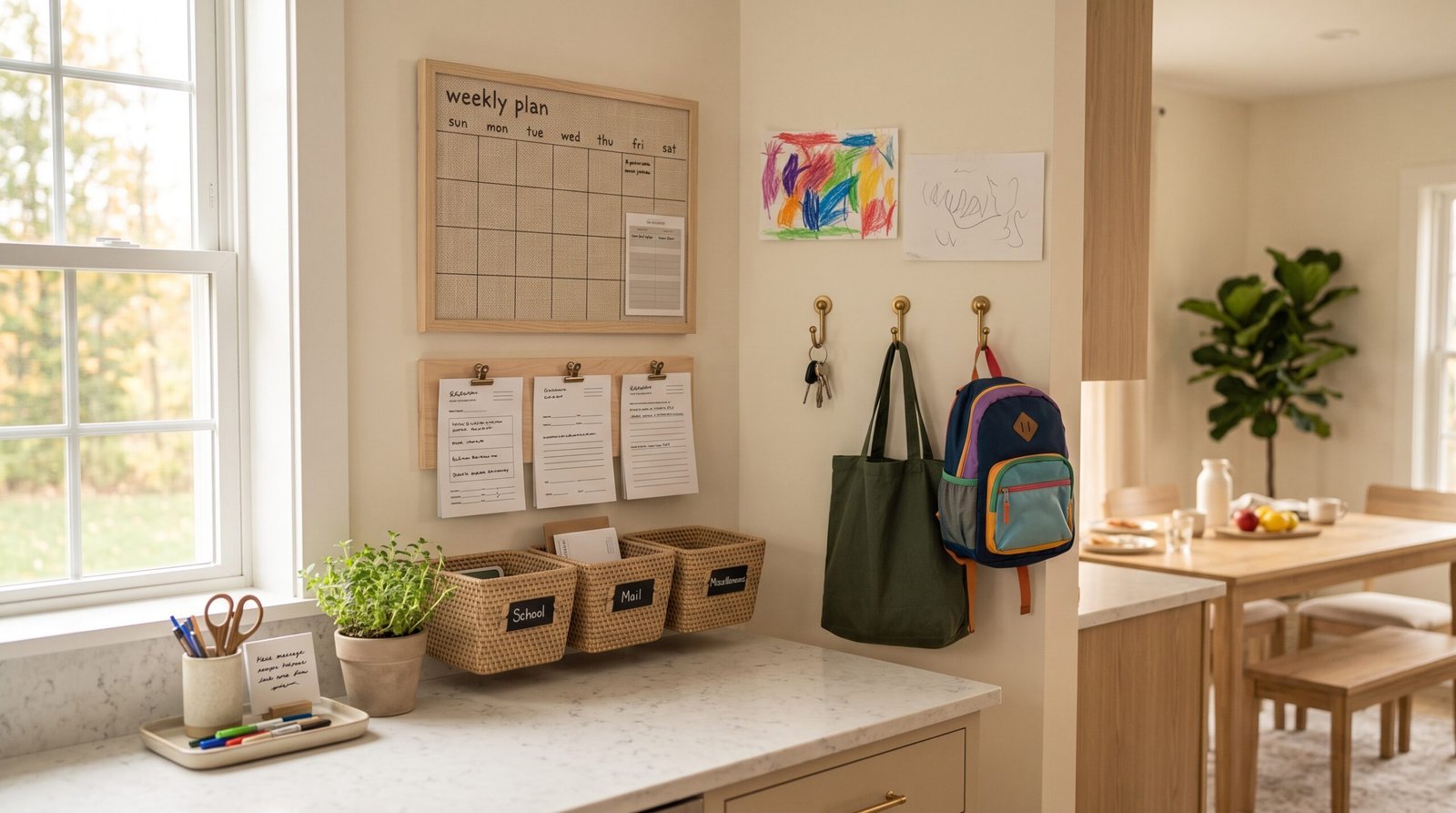
A simple family schedule can be placed somewhere everyone sees it.
The refrigerator, kitchen wall, family command center, or another central location can work.
For younger children, pictures can be more useful than written instructions.
For older children, a simple checklist or weekly calendar may be enough.
You can also separate daily routines from weekly responsibilities.
For example:
Daily
- Morning routine
- School preparation
- Homework
- Evening reset
- Bedtime
Weekly
- Laundry
- Grocery shopping
- Cleaning bedrooms
- Meal planning
- Family activities
This keeps the daily routine from becoming overloaded with tasks that don’t actually need to happen every day.
When a Family Routine Doesn’t Work
Sometimes you create a routine that looks perfect on paper and fails completely in real life.
That’s useful information.
Instead of deciding that your family is bad at routines, ask whether the routine itself needs to change.
Maybe there are too many steps.
Maybe the timing is unrealistic.
Maybe the children need more transition time.
Maybe you’re trying to fit too much into one part of the day.
Maybe the routine depends on one person doing everything.
Adjust it.
A routine isn’t supposed to be permanent.
Your family changes as children grow, school schedules change, activities change, and responsibilities change.
The routine should change too.
How to Create a Simple Family Routine That Doesn’t Feel Overwhelming
If you’re starting from scratch, don’t try to organize everything at once.
Begin with three anchor points:
Morning
What needs to happen before everyone leaves?
After school
What usually happens when everyone gets home?
Evening
What needs to happen before bedtime?
Once these three parts are working reasonably well, you can add other routines.
You might eventually create routines for:
- Meal planning
- Laundry
- Grocery shopping
- Homework
- Weekend cleaning
- Family activities
- Preparing for school
- Household organization
But there’s no need to build all of them on day one.
A routine becomes useful when it reduces mental effort.
It shouldn’t create more work.
The goal of how to create a simple family routine is not to add more tasks to your day, but to make the tasks you already have easier to manage.
A Simple Family Routine Example
If you’re not sure where to start, here’s an example of a flexible weekday routine.
Morning
Wake up
Get dressed
Eat breakfast
Brush teeth
Check backpacks
Put on shoes
Leave
After School
Come home
Put belongings away
Have a snack
Take a short break
Complete homework or activities
Prepare for dinner
Evening
Eat dinner
Help clean up
Prepare belongings for tomorrow
Family time
Begin bedtime routine
Read or relax
Go to bed
This isn’t a rule.
It’s simply a framework.
You can adjust it based on your children’s ages, work schedule, school requirements, activities, and household needs.
The best routine is the one that makes sense for your particular family.
Use Your Home to Support the Routine
Sometimes the easiest way to improve a routine is to change the environment around it.
If backpacks are always left in the hallway, create a designated backpack area near the entrance.
If shoes constantly pile up by the door, place a basket or shoe rack nearby.
If school papers disappear under piles of mail, create one simple location for them.
If children struggle to find their belongings, make storage easier to access.
Organization and routine work together.
You can also use the home organization ideas in our guide on how to organize your home as a busy mom to create simple storage systems that support your family’s daily habits.
The goal isn’t to make your home look perfect.
It’s to make the things your family does every day easier to complete.
Don’t Forget Family Time
A family routine shouldn’t be nothing but chores, homework, and responsibilities.
Make room for connection too.
That could mean eating dinner together when possible, reading a book, taking a short walk, playing a game, talking before bed, or simply sitting together without everyone being distracted by a screen.
Family time doesn’t have to be elaborate.
Often, the small predictable moments are the ones children remember.
A routine should create space for your family to function—not simply create a longer list of things everyone needs to accomplish.
When Life Gets Messy, Start Again
There will be days when your routine completely falls apart.
That’s part of family life.
You may have a late appointment.
A child may have a difficult day.
You may be exhausted.
The house may be messy.
Dinner may happen much later than planned.
Don’t interpret one chaotic day as proof that your routine doesn’t work.
Simply return to the basics the next day.
Choose the few things that matter most and start there.
A successful family routine isn’t one that is followed perfectly.
It’s one that gives your family something familiar to return to.
That’s ultimately what how to create a simple family routine is about: creating structure that makes everyday family life easier without making it feel rigid.
The Bottom Line
Learning how to create a simple family routine that actually works isn’t about controlling every hour of the day.
It’s about creating a few predictable habits that make everyday life easier.
Start with the moments that cause the most stress.
Keep routines simple.
Give children age-appropriate responsibilities.
Prepare for busy mornings the night before.
Create a short evening reset.
Use visual reminders when helpful.
And leave enough flexibility for real life.
Most importantly, don’t compare your family’s routine with someone else’s.
Your family has its own schedules, personalities, responsibilities, and challenges.
A routine that works beautifully for another household may be completely wrong for yours.
The best routine is the one your family can understand, follow, adjust, and return to when life gets busy.
You don’t need a perfect schedule.
You need a little structure, a little flexibility, and systems that make everyday life feel more manageable.
Sometimes, that is enough to turn a chaotic day into one that feels a little calmer.
Post Comment